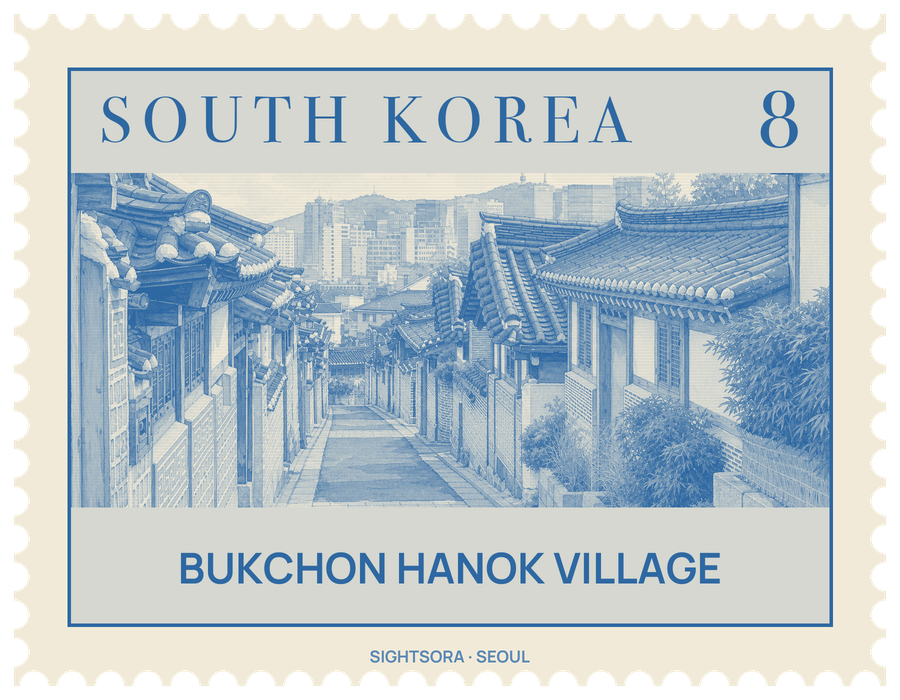
Its name means "north village", since it lies north of the stream Cheonggyecheon and of Jongno, and it takes in the neighbourhoods of Gahoe-dong, Gye-dong, Jae-dong, Wonseo-dong and Insa-dong. Some of the hanok now house businesses, among them artisans such as Kum Bak Yeon, a workshop that applies gold leaf to clothing.
For centuries this was where high-ranking officials and the nobility lived; a family register of 1906 shows that 43.6% of the population belonged to that class, and late Joseon figures such as Pak Yŏnghyo and Kim Okkyun kept large houses here. Much of the village visitors walk through today, however, is the work of one developer. Around 1920 Chŏng Segwŏn set up his property company, Kŏnyangsa, and rebuilt the area as hanok rather than Japanese-style buildings, by his family's account to keep it out of Japanese hands. His houses were smaller than the old mansions and came with glass windows and electricity, which let Koreans of more modest means move in. He used the profits to support nationalist causes such as the Korean Language Society, and after the 1942 crackdown on the society he was tortured and lost much of his property.
Hanok went on being built here until the early 1960s. As schools and institutions moved south of the Han River from the late 1960s, the character of the area began to shift, and in 1976 it was designated a folk landscape; a 1983 designation then limited new modern construction. After the rules were eased in 1991 and again in 1994, more hanok gave way to multi-storey homes and large projects in 1993 and 1996 cleared dozens of them, and the rules were rewritten in 1999 and 2001 with residents' views built in. The houses remain homes: around 6,100 people lived in the village in 2024, the same year it received 6.4 million visitors.