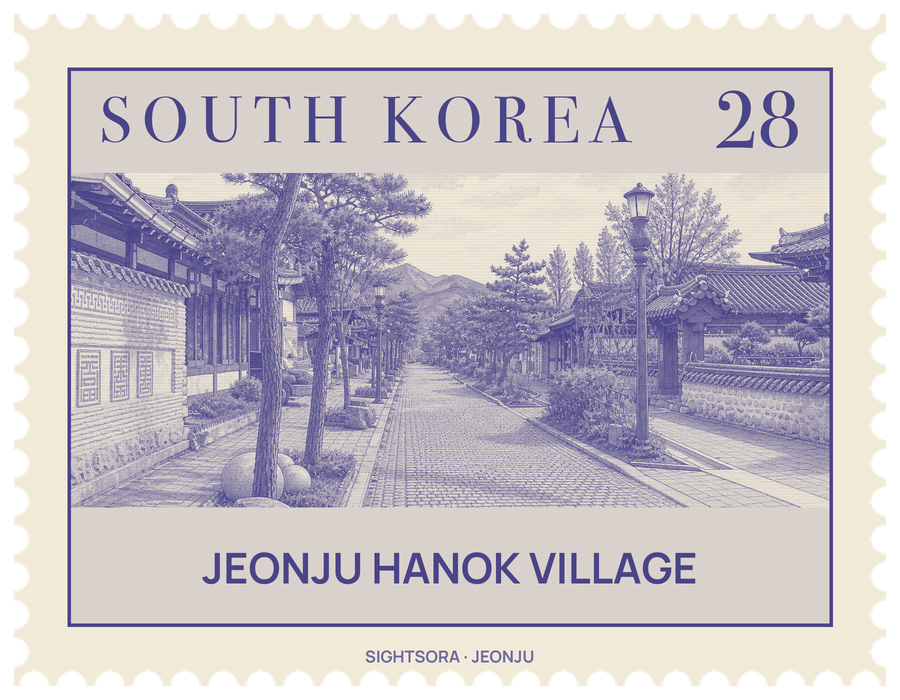
The village was named an International Slow City in 2010 for its unhurried pace of life, in which traditional culture and nature sit together.
Jeonju has deep roots: it was the capital of the Hubaekje Kingdom founded by Kyŏn Hwŏn in the 900s, and under the Joseon Dynasty it was honoured as the dynasty's spiritual home, since the Yi royal family came from here, and it governed the Jeolla-do region together with Jeju Island. Villages grew up around the city's defensive wall, and when the wall was pulled down in the Korean Empire period, the residential quarter spread through Pungnam-dong and Gyo-dong under the lead of the yangban gentry, forming the village seen today.
Gyeonggijeon, at the front of the village, is where many visitors begin. Built in 1410, it enshrines the portrait of Lee Seonggae, founder of the Joseon Dynasty, which is National Treasure #317; the hall was once larger, but its western side and annex were torn down in the colonial period for a Japanese elementary school, leaving a simple building linking a set of outer and inner gates. On the east side of the village, Omokdae marks the high ground where Lee Seonggae held an outdoor banquet on his way back to Gaegyeong after defeating Japanese coastal raiders at Hwangsan Mt., and its height gives a good view of the surroundings.
Jeondong Catholic Church, completed in 1914 to a design by Priest Poinel, who also designed Myeongdong Cathedral in Seoul, mixes Romanesque and Byzantine styles and stands where Yun Ji-chung, the first Korean Catholic martyr, was put to death. Jeonju Hyanggyo, a Confucian shrine and school first founded in 1354 under the Goryeo Dynasty and moved twice after wars, has 99 rooms and an unusual layout, with the shrine hall, Daeseongjeon, at the front and the lecture hall, Myeongyundang, behind it.
Pungnam Gate, the southern entrance through the wall that enclosed Jeonju in the Joseon Dynasty, was the only gate left standing once the wall was gone; it was restored over three years from 1978, and the arrangement of the columns on its second storey is a rare Korean building style. At the Traditional Hanji Center, Korean paper is made by traditional methods, and visitors can join papermaking programmes, including designing patterns for the paper.