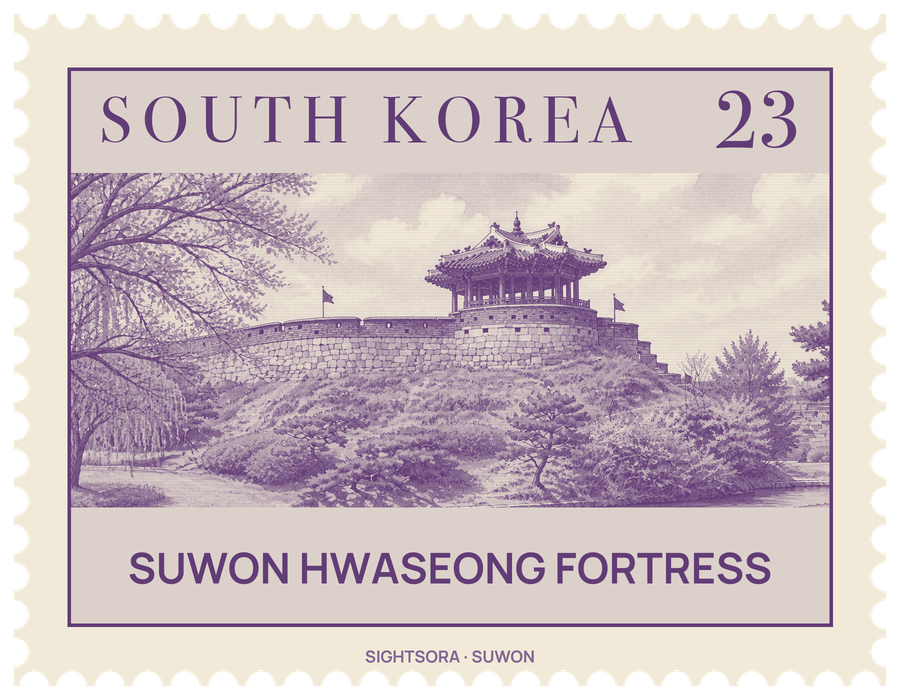
King Jeongjo, the 22nd king of Joseon, who reigned from 1777 to 1800, had it built between 1794 and 1796 after moving the tomb of his father, Crown Prince Sado, to Suwon. Together with the palace inside it, the fortress was named a UNESCO World Heritage Site in 1997.
Jeongjo seems to have intended Suwon as a new capital, away from the factional quarrels of the court in Seoul, and the fortress was planned to combine a town wall, a defensive stronghold and a town centre in one, instead of the older Korean pattern of a plain town wall with a separate mountain refuge. Its architect, Chŏng Yagyong, drew on Korean and Chinese fortress designs and on the science of the Silhak, or practical learning, movement: brick was used as a building material, pulleys and cranes lifted the stones, and the workers were paid wages rather than drafted. After heavy damage during the Korean War, the walls were rebuilt in the 1970s from the Hwaseong Seongyeok Uigwe, ten volumes published in 1801 that set down the plans, drawings, materials and wages of the original work.
The wall rises between 4 and 6 metres and can be walked all the way round. Of the four main gates, Janganmun to the north and Paldalmun to the south carry two-storey wooden pavilions, while Hwaseomun to the west and Changnyongmun to the east have one storey. Each main gate is ringed by a miniature fortress once manned by guards, and the north and south gates also have a semicircular outer wall, an ongseong. Paldalmun is cut off by traffic, standing on a roundabout, and holds a bell first cast in 1080 and recast in 1687. To the north, Hwahongmun lets the Suwoncheon into the fortress under seven arches; beside it, the North-East Pavilion looks down on a small garden pond, Yongyeon.
Along the circuit stand turrets, sentry posts, gun towers, secret gates and command posts. The beacon tower, Bongdon, has five chimneys: one fire meant peace, and each added one signalled a worse threat, up to five for fighting under way. The North-East Observation Tower is an oval of three storeys with a spiral staircase inside, and the East Command Post faces an archery field near Changnyongmun. On the crest of Paldalsan, the West Command Post, Seojangdae, stands beside an octagonal brick crossbow platform, and from there a spur of wall runs south-west to a pavilion with a wide view over the city.
At the eastern foot of Paldalsan lies Haenggung, a palace of the kind kings used when travelling, in wartime or when visiting tombs; Jeongjo stayed here on his visits to his father's tomb. Built in 1789 and enlarged in 1794–1796, it is a group of 22 buildings entered through the main gate Sinpungnu. Bongsudang is the hall where the 61st birthday of the king's mother, Lady Hong, was celebrated, Nangnamheon hosted state examinations and a banquet for the poor, and Deukjungjeong was the king's archery pavilion. Most of the palace was destroyed in the colonial period; restoration began in 1996 and it opened to the public in October 2003. Next to it, Hwaryeongjeon, built in 1801, is a shrine that keeps a portrait of Jeongjo rather than an ancestral tablet.