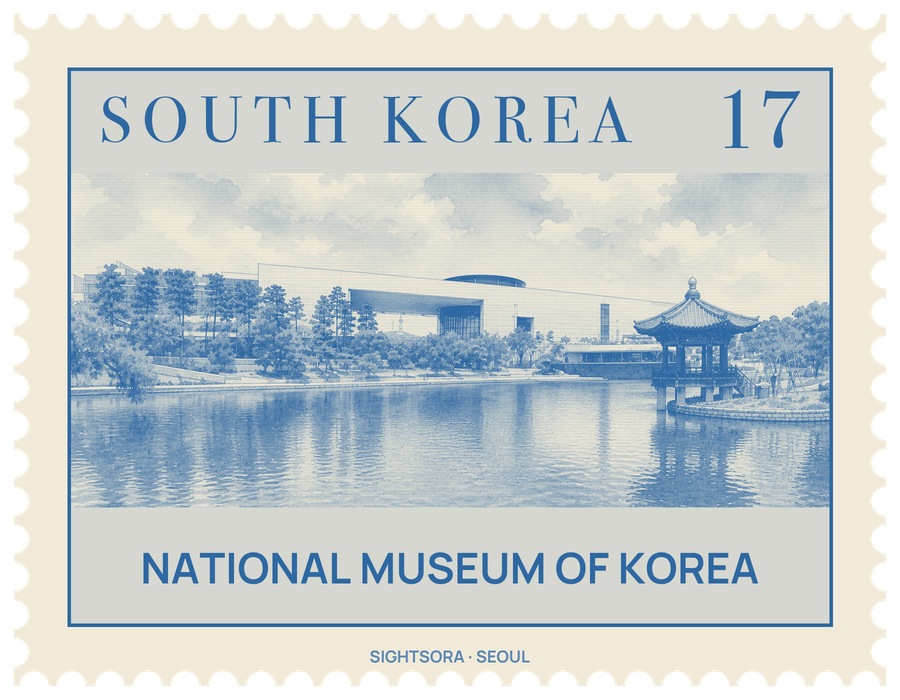
Its grounds, Yongsan Family Park, were once a golf course on the Yongsan Garrison, the base from which United States Forces in Korea were commanded; the land was handed back in 1992, and the museum opened in its new building there on October 28, 2005.
The collection goes back to the Imperial Household Museum that Emperor Sunjong founded in 1909, and the national museum itself was established in 1945. During the Korean War its 20,000 pieces were moved to Busan for safety, and in the following decades it changed homes several times, from Gyeongbokgung and Deoksugung Palace to the former Japanese General Government Building, before settling in Yongsan. The new building was designed to withstand a magnitude 6.0 earthquake, with shock-absorbent platforms under its display cases and natural lighting in the galleries. The left side of the building is meant to stand for the past and the right side for the future.
The permanent galleries move through Korean history and beyond. The Prehistory and Ancient History Gallery covers the Paleolithic to the Unified Silla era with about 4,500 artefacts, including finds from sites such as the Bangudae Petroglyphs and Songgung-ni, and rooms for Goguryeo, Baekje, Gaya and Silla. The Medieval and Early Modern History Gallery continues through Unified Silla, Balhae, Goryeo and Joseon. Further galleries are given to calligraphy and painting, to donated private collections, to sculpture and crafts, including Goryeo Celadon, and to Asian art, where Indian, Southeast Asian, Central Asian, Chinese and Japanese pieces sit alongside the Sinan Undersea Relics.
Among the best-known pieces is a fifth-century Silla gold crown, National Treasure No. 191, dug up in the North tomb of Hwangnamdaechong in Gyeongju, where finds such as a belt ornament inscribed "Madame's belt" suggest a woman was buried. The Pensive Bodhisattva, made early in the seventh century, is a seated figure lost in thought, one leg over the other and fingers touching its cheek, under a flat Three Mountain Crown. A twelfth-century Goryeo celadon incense burner with openwork, National Treasure No. 95, and an album of twenty-five genre paintings of common people by the 18th-century painter Kim Hong-do, known as Danwon, are also in the collection.
Inside the museum's Path to History stands the Gyeongcheonsa Ten-Story Pagoda (National Treasure No. 86), first raised at the monastery in 1348. It was smuggled to Japan in 1907 and returned in 1918, and after acid rain and weathering damaged it outdoors at Gyeongbokgung it was taken apart in 1995 and rebuilt indoors for the museum's opening in 2005. On the ground floor, parks, waterfalls, pools and gardens of native plants surround pagodas, stupas, lanterns and steles, among them the Great Bell of Bosingak.