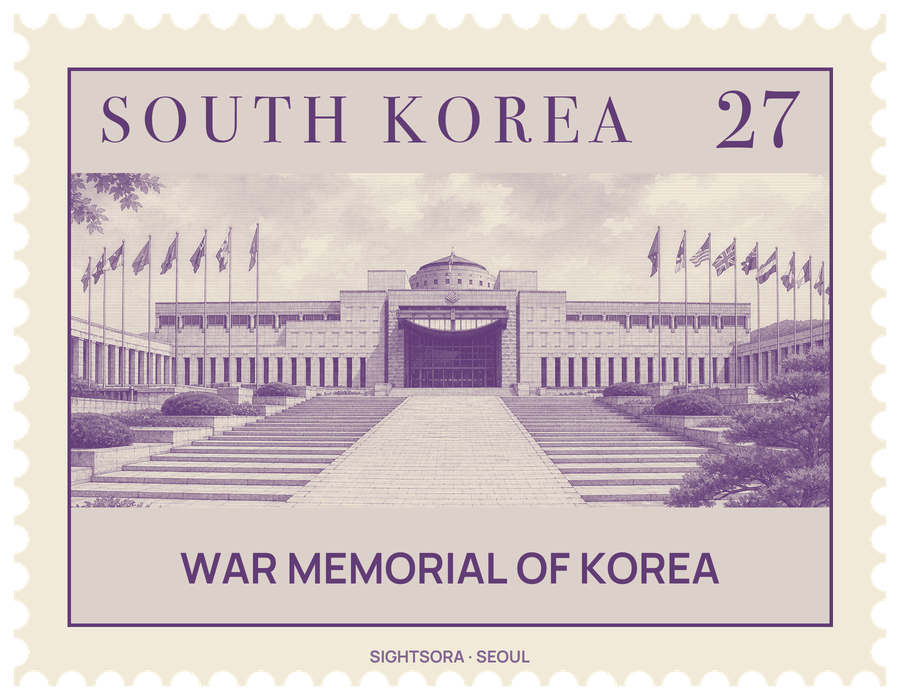
It opened on June 10, 1994, with the stated aim of preventing war by learning from the Korean War of 1950–1953 and of looking towards the peaceful reunification of North and South Korea.
Cloistered galleries flank the front of the main building, lined with black marble monuments carrying the names of those who died in the Korean War and the Vietnam War, in clashes with North Korea after 1953, and of policemen killed on duty; the inscription at the entrance of the memorial halls also names the United Nations soldiers who fell in Korea. The plaza in front has an artificial waterfall and rest areas, and at its centre stands the Statue of Brothers, which pairs an elder brother in South Korean uniform with a younger one in North Korean uniform as a symbol of the divided country.
The main building has three floors of exhibits above ground plus two underground floors, and some 6,300 items are on display across its halls and the outdoor area. The displays run from the arms of prehistory to modern equipment and portray notable military figures, with separate spaces for the Korean War, the expeditionary forces, the ROK Armed Forces and donated artifacts. Among the larger pieces indoors are a full-sized replica of a turtle ship, a Katyusha rocket launcher, a Cadillac used by Syngman Rhee and a ZIL limousine once used by Kim Il Sung, and aircraft such as a MiG-15UTI trainer and an F-51D Mustang that flew for the ROKAF in the Korean War.
The outdoor area is filled with aircraft, helicopters, guns and boats. There is a B-52D Stratofortress that served in the Vietnam War, a C-119 Flying Boxcar, F-86 Sabres, an F-5A Freedom Fighter in tiger-head markings, and a Shenyang J-6, a Chinese copy of the MiG-19, flown to South Korea by a defecting North Korean pilot on 25 February 1983. Other pieces include Buhwal-ho, the first aircraft built in Korea, an Alouette III helicopter with a kill marking for a North Korean infiltration boat it sank in 1983, a captured North Korean infiltration craft, and a patrol boat painted to recall one sunk in the Second Battle of Yeonpyeong.