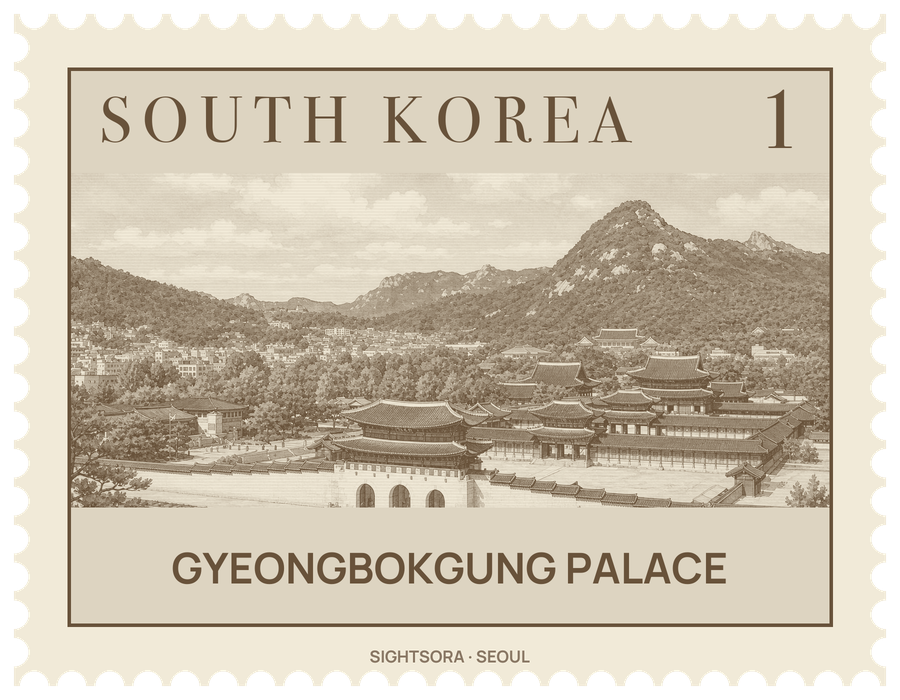
The official Chŏng Tojŏn chose its name, which means 'great blessings palace', from a line of the Classic of Poetry. Under Sejong the Great, who ruled from 1418 to 1450, it became the working centre of the state: scholars of the Hall of Worthies helped him create the Hangul script here, and the grounds held a water clock and an astronomical observatory.
Little of what stands today is that first palace. Fire destroyed it in 1592 during the Imjin War, and for around 270 years it lay mostly unused. The regent Queen Sinjeong ordered its reconstruction in 1865, and by 1888 the rebuilt palace held around 500 buildings. In 1895 Japanese agents killed Queen Min at Geoncheonggung, a residence within the palace. After Japan annexed Korea, the colonial government sold off and demolished building after building, so that only 40 of them survived to 1945, and raised its own Government-General Building inside the grounds; that building was finally pulled down in 1995 and 1996. A restoration plan that began in 1990 had recreated 89 buildings by 2010, and a second plan launched that year aims at 90 more.
The main buildings follow a north–south axis through three gates and three courtyards, a sequence taken from an ancient Chinese text on palace design. Gwanghwamun, the front gate, opens onto the outer court once used by government offices; Geunjeongmun leads to the second court, where the king dealt with his officials and where the hall Geunjeongjeon stands; and Hyangomun gives onto the private quarters of the royal family. Geunjeongjeon and Gyeonghoeru both appeared on the back of the 10,000 won note. Look out for the dragon-shaped water spouts placed around the palace, which were probably meant in part as guardians against fire, and for the stone markers that show where vanished buildings once stood. A 2020 survey counted 9,499 trees of 135 species in the grounds.
The National Palace Museum of Korea occupies a modern three-storey building in the southwest of the grounds and shows objects from the former royal family. A reenactment of the changing of the royal guard has been staged at the palace since 2002. Many visitors tour the courtyards in hanbok, traditional Korean clothing, rented from shops near the palace; in 2024 some 1.8 million of them did so. To the south the palace looks out over Gwanghwamun Square and the Sejong Center, and to the north lies the Blue House.
Getting there
Gyeongbokgung Station on the Seoul subway serves the palace.