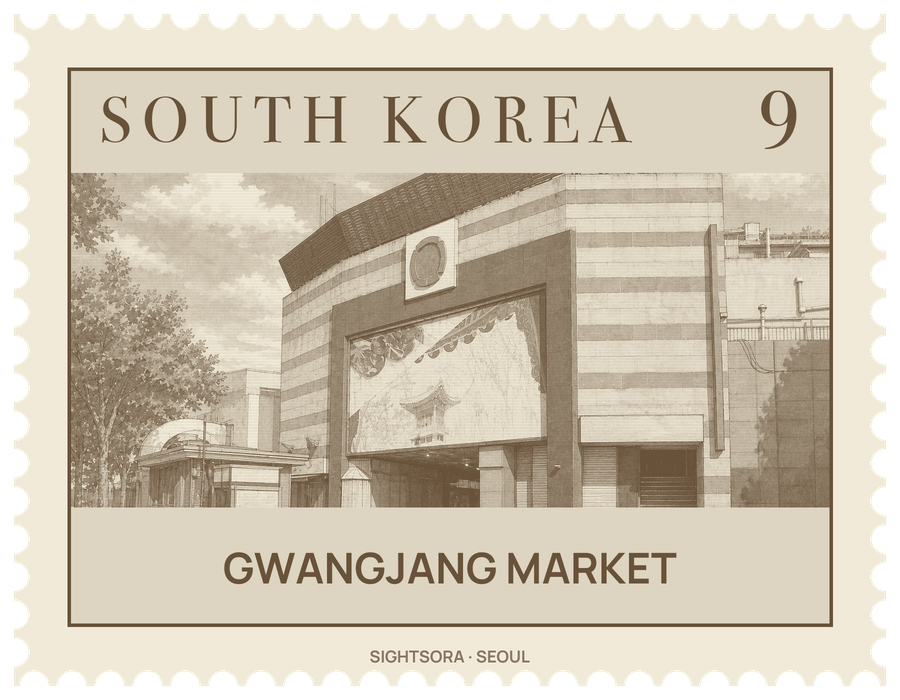
Roughly 1500–2000 vendors sell fruit, vegetables, meat, fish and bread alongside clothing, textiles, handicrafts, kitchenware, souvenirs and traditional Korean medicinal goods. Its restaurants and food stalls serve traditional Korean dishes, and the market is best known for bindaetteok, pancakes of ground mung beans fried at the stalls, and for mayak gimbap; kal-guksu noodles and gejang also feature among its street foods.
The market grew out of resistance to colonial control. After the Eulsa Treaty of 1905 the Japanese took over Namdaemun Market, and a group of Korean merchants and investors pooled their money, founding the Gwangjang Corporation on 5 July 1905 to buy land for a market of their own. They built it on the site of the Bae O Gae morning market and called it Dongdaemun Market; unlike most markets of the time, which were temporary and met only now and then, it traded every day. The current name, adopted in 1960, came from a shopping centre built in the middle of the market between 1957 and 1959 and named after two nearby bridges, Gwangkyo, the "wide bridge", and Jangkyo, the "long bridge". The association that runs the market dates from 1911.
Getting there
Two metro stations serve the market: Jongno 5-ga and Euljiro 4-ga.