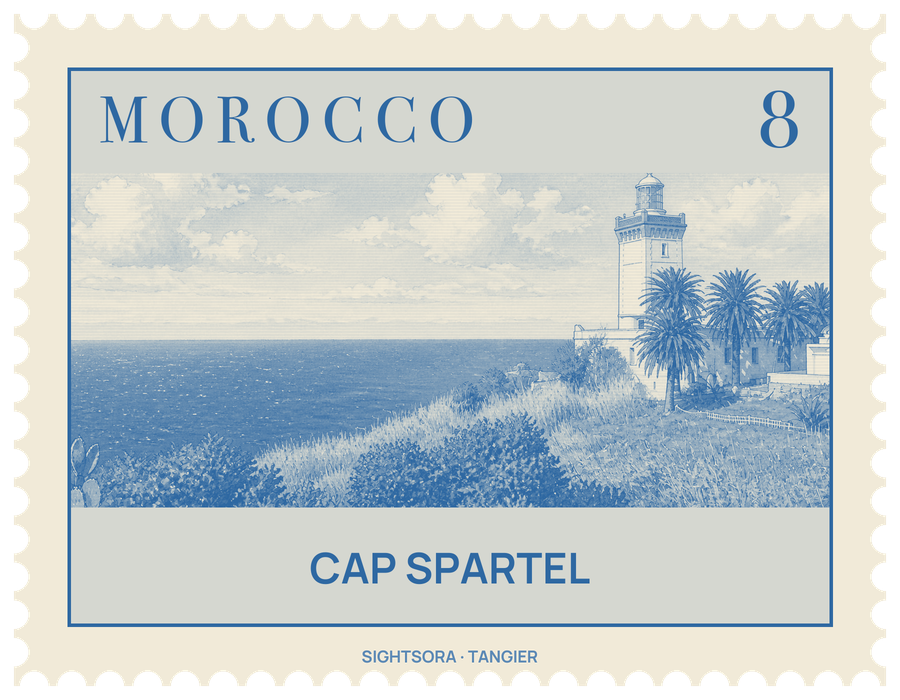
No point of the African mainland lies further northwest, though the cape it is often wrongly called the northernmost, a title that belongs to Ras ben Sakka in Tunisia. Its high point is Jebel Quebir, 326 m above the sea, and the lighthouse that Sultan Muhammad IV had built in 1864 stands at the end of a cliff there.
The lighthouse also marks a line on the map: under international law its longitude, 5° 55' W, is the western limit of the Mediterranean Sea, so the waters of the Mediterranean and the Atlantic are taken to meet here. During the colonial period a consortium of Western powers kept the light running. Offshore lies Spartel Bank, a sunken island that some have suggested as the site of the legendary Atlantis.
These waters have seen a string of sea fights. In 1670 English and Dutch squadrons destroyed six Barbary pirate ships near the cape; in 1704 an English squadron captured two newly built Spanish warships off it; in 1782 British and Franco-Spanish fleets fought an inconclusive battle offshore over supplies for besieged Gibraltar; and in 1936, early in the Spanish Civil War, two Nationalist cruisers broke the Republican blockade of the strait here. The liner Delhi went aground close by in 1911; every passenger was saved, but three French rescuers lost their lives.
A renovation of the whole site, begun in 2020 and finished in 2021, added a maritime museum, a botanical garden, a restaurant and an event space around the lighthouse, and visitors can climb to its top for views over the Strait of Gibraltar. Below the cape, reached from Robinson Plage, are the Caves of Hercules, which were occupied in the Neolithic and were later widened by quarrying of the rock.
Getting there
The cape lies west of Tangier and is reached by road from the National Road S701.