It began as a Berber settlement in the 3rd century BC, had a Carthaginian presence, probably served as a capital of the kingdom of Mauretania under Juba II, and grew fast under Rome from the 1st century AD to cover about 42 hectares. At its height in the late 2nd century some 20,000 people lived here, most of them Romanised Berbers, and the wealth came above all from olive oil. UNESCO listed it as a World Heritage Site in 1997 as an exceptionally well preserved Roman colonial town on the edge of the empire.
Rome lost its hold around 285 and never came back, but the town lived on for centuries, first as a Latinised Christian community and then as Walili, home of the Berber Awraba tribe. In 787-8 Moulay Idriss was proclaimed imam here and founded the Idrisid dynasty; he was assassinated here in 791, and when his son Idris II moved to Fes the town lost its last political role. Its people were largely moved to the nearby town of Moulay Idriss Zerhoun, and locals came to call the ruins Ksar Faraoun, the Pharaoh's Castle. Moulay Ismail stripped stone from the site for Meknes in the 17th century, and the 1755 earthquake brought down much of what was left. French archaeologists began digging in 1887, and about half the city has now been uncovered.
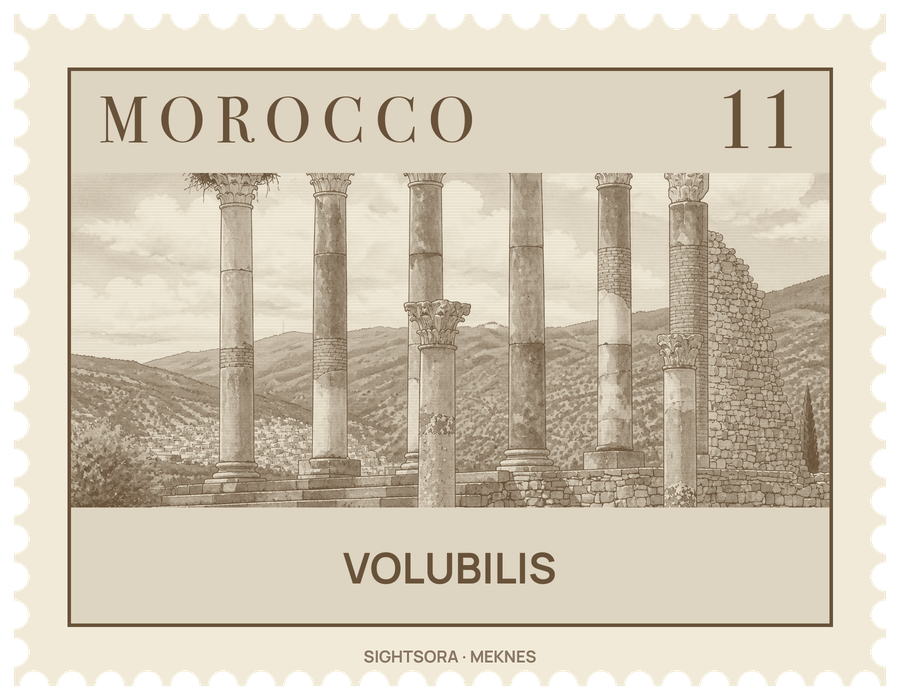
The main street, the Decumanus Maximus, runs between the reconstructed Tingis Gate of 168/169 AD and the Arch of Caracalla, put up in 217 by the governor Marcus Aurelius Sebastenus in honour of the emperor and his mother Julia Domna. A bronze chariot with six horses once crowned the arch; its inscription was pieced back together from fragments sketched lying on the ground by the English antiquarian John Windus in 1722, and the French rebuilt the arch in 1930–34. Near the centre stand the basilica, the hall of justice and city government, completed in the early 3rd century and 42.2 m long, and behind it the Capitoline Temple of Jupiter, Juno and Minerva, reached by 13 steps, 10 of them rebuilt in 1962. Midway across the excavated area, where the earlier and Roman quarters meet, rises a large tumulus whose purpose is still unknown.
The grand houses behind the main street are what Volubilis is best known for, and several still have their mosaics in place. The House of the Ephebe shows Bacchus in a chariot drawn by leopards, the House of Venus has Diana and her nymph surprised by Actaeon, and the House of the Labours of Hercules keeps a mosaic of the Four Seasons. The finest bronzes found here, among them a bust of Cato the Younger, are now in the archaeological museum in Rabat. Olive oil was everywhere in daily life, and the remains of dozens of oil-pressing complexes survive; one workshop at the southern end of the town has been given a life-size copy of an ancient press.
Just outside the walls, on the floodplain of the Oued Khoumane, excavations from 2000 uncovered a group of courtyard buildings that coins and pottery place in the time of Idris I, and they are taken to be his headquarters. Their hammam, with a cold room, plunge pool and a vaulted warm room, can still be traced, along with grain silos and a reception courtyard.