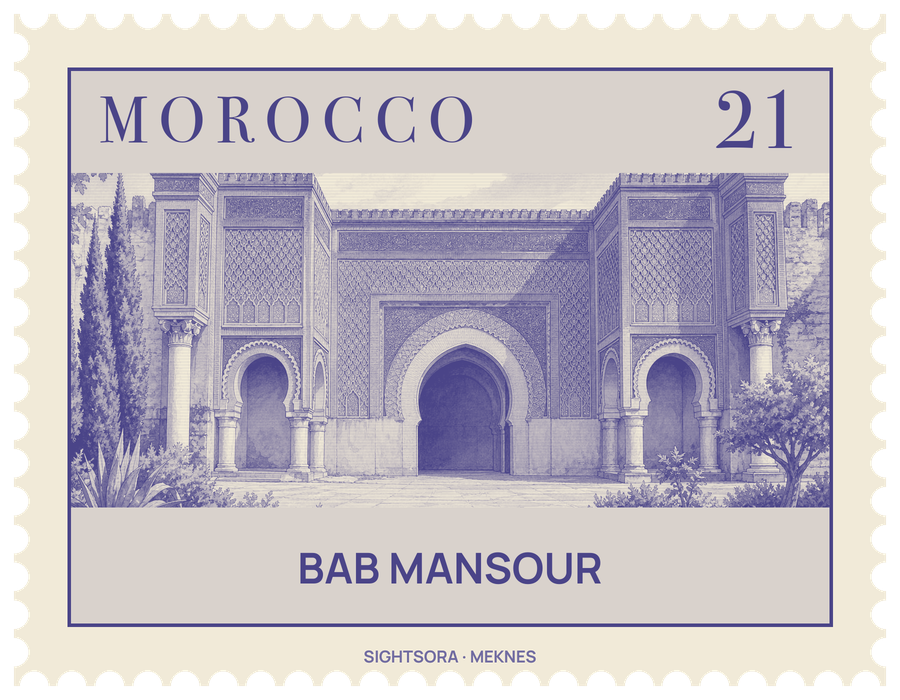
It was built as the main entrance to the Kasbah, the royal citadel of Sultan Moulay Isma'il, and was meant more to impress visitors than to defend the walls. Moulay Isma'il started it toward the end of his reign, and his son Moulay Abdallah completed it in 1732.
Its architect and designer gave the gate its name: Mansour al-'Alj, "the Victorious Apostate", had been a Christian slave before he embraced Islam. Its plan, a large horseshoe arch set between two bastions, takes after Almohad models like Bab Agnaou and the gate of the Udayas kasbah, but it adds new ideas of its own. The square bastions stand on four thick, squat columns linked by horseshoe arches, leaving an open loggia at their base, and beyond them massive marble columns hold up projecting pilasters. Those columns, with their ornate composite capitals, are Roman, probably taken from the nearby site of Volubilis.
Almost every surface of the facade is covered by a repeating darj-wa-ktaf lattice, a lozenge-like Moroccan pattern, whose gaps are filled with polychrome zellij mosaic; tilework on this scale was something new for Moroccan monumental gates. Painted arabesque tiles fill the spandrels of the arches, and along the full width of the top runs a long Arabic inscription in tiles describing the gate's construction. Behind the arch, the passage turns 90 degrees twice to cross the gap between the double walls of the Kasbah and comes out on Place Lalla Aouda.
Further southwest on the same wall, a little way off, is a second, smaller gate, Bab Jama' en-Nouar, with similar decoration and believed to date from Moulay Isma'il's time as well.