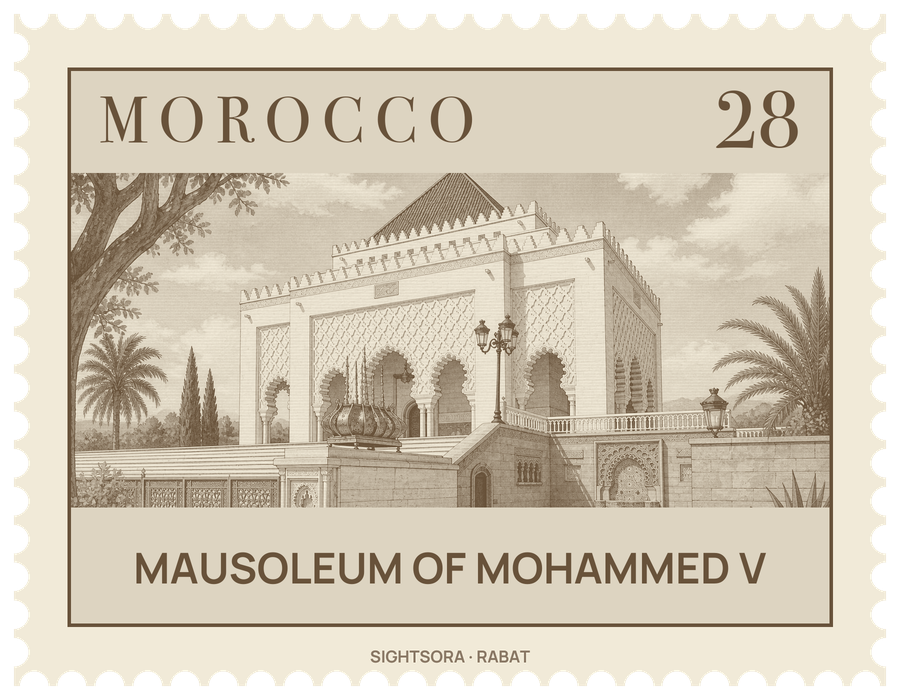
It holds the tombs of King Mohammed V, who died in 1961, and of his two sons, King Hassan II and Prince Abdallah. Hassan II commissioned it, and the Vietnamese architect Cong Vo Toan designed the complex in traditional forms built with modern materials.
Work began in 1961 and was completed in 1971, when the body of Mohammed V was moved here; Prince Abdallah was buried here in 1983 and Hassan II in 1999. The building was conceived as a showcase of historic Moroccan crafts and motifs, a tribute to the king's efforts to promote traditional craftsmanship as part of a Moroccan identity. The project also renovated the open esplanade of the Almohad mosque, now in ruins, whose minaret is the Hassan Tower.
Outside, the reinforced concrete structure is clad in white marble and ringed by porticoes of polylobed Moorish arches, with the walls above them carved in the Moroccan sebka pattern; members of the royal guard stand among the columns. Inside, the tomb chamber rises to a dome of mahogany and coloured glass over walls covered in zellij tilework, with details in chased brass. The king's white onyx cenotaph is the work of the craftsman Ibn Abdelkrim, and a Quran reader often sits in his assigned place beside it.
The mausoleum is one part of a larger ensemble. Facing it to the west, on its own raised platform at the southwestern corner of the old mosque, stands a rectangular open-air pavilion of arches, designed as a museum of the Alaouite dynasty. Between the two lies a mosque built with the complex and kept lower so as not to block the view of either; its hypostyle hall has separate sections for men and women around a courtyard paved in marble.