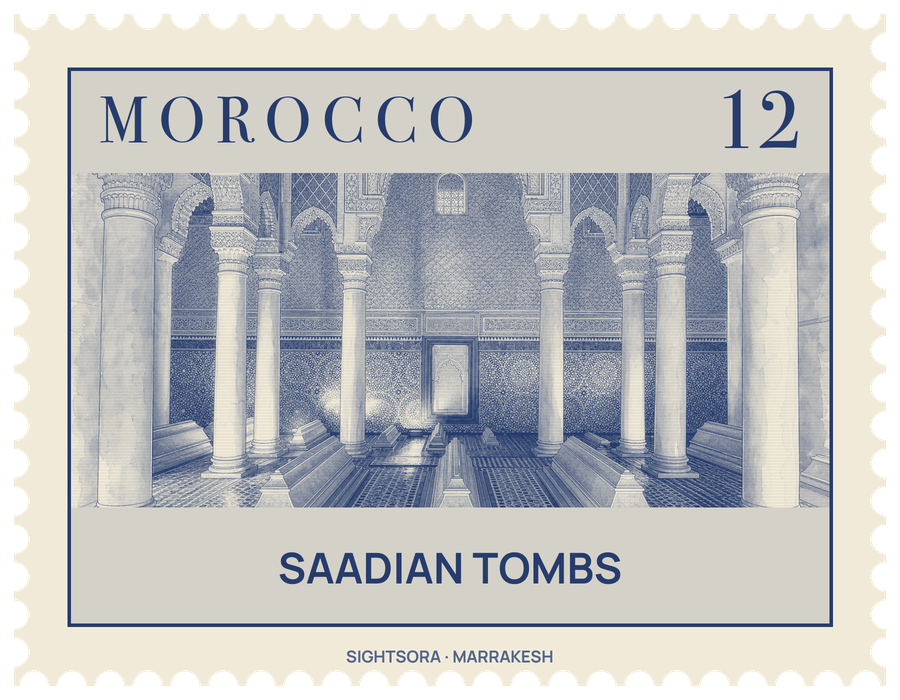
Two mausoleums stand inside: a western building beside the entrance and an older one to the east, surrounded by gardens. Most of what survives dates from the reign of Ahmad al-Mansur, from 1578 to 1603, and many art historians see the complex as the peak of Saadian architecture for its rich decoration and carefully planned interiors.
The ground was probably a burial place long before the Saadians. Around 1557–74 Moulay Abdallah al-Ghalib raised a small square mausoleum here over the grave of his father, Muhammad al-Shaykh, founder of the dynasty. Ahmad al-Mansur later enlarged it after burying his mother, Lalla Mas'uda, there in 1591, and then turned to an entirely new building to the west for his own tomb. Royal burials went on after the Saadians, but the sultan Moulay Isma'il sealed the necropolis off, and over time it was cut off from the streets around it. In 1917 the fine arts and historic monuments service set up under the French Protectorate rediscovered the tombs, restored them and opened them to the public for the first time.
The eastern building, often called the Qubba of Lalla Mas'uda, centres on a chamber only 4 meters square under a vault of fine stucco muqarnas that keeps traces of blue and gold paint; its lower walls carry zellij with star patterns, and the marble panel dedicated to Lalla Mas'uda beside her tomb is the best preserved of its kind in the necropolis. A larger hall to the south has a painted wooden berchla ceiling and tilework with 16-sided stars, and two loggias open onto the garden under cedar canopies resting on marble columns.
The highlight is Ahmad al-Mansur's own Chamber of the Twelve Columns in the western building, 10 meters square and 12 meters high. Twelve columns of Carrara marble, grouped in threes, support small arches also carved in marble, blending into stucco arches so smoothly that the change of material is hard to see. Above them, cedar ceilings painted mainly in red and gold include a central star-patterned cupola that recalls the far larger one over the Alhambra's Hall of Ambassadors. Al-Mansur's tombstone lies at the centre, flanked by those of his son Moulay Zidan and of Muhammad al-Shaykh al-Saghir; these and two more royal tombstones are the largest and finest in the complex.
Since the original entrance through the neighbouring Chamber of the Mihrab is closed, visitors look into the mausoleum from an opening in its east wall that was once a window. The Chamber of the Mihrab, meant as a prayer room, has a horseshoe-arched mihrab whose lower decoration was never finished, and it later filled with graves of the Alawi family. The Chamber of the Three Niches beyond has some of the most intricate stucco in the complex. Altogether the necropolis holds 56 tombstones with carved marble epitaphs and roughly a hundred more graves marked only with tiles.