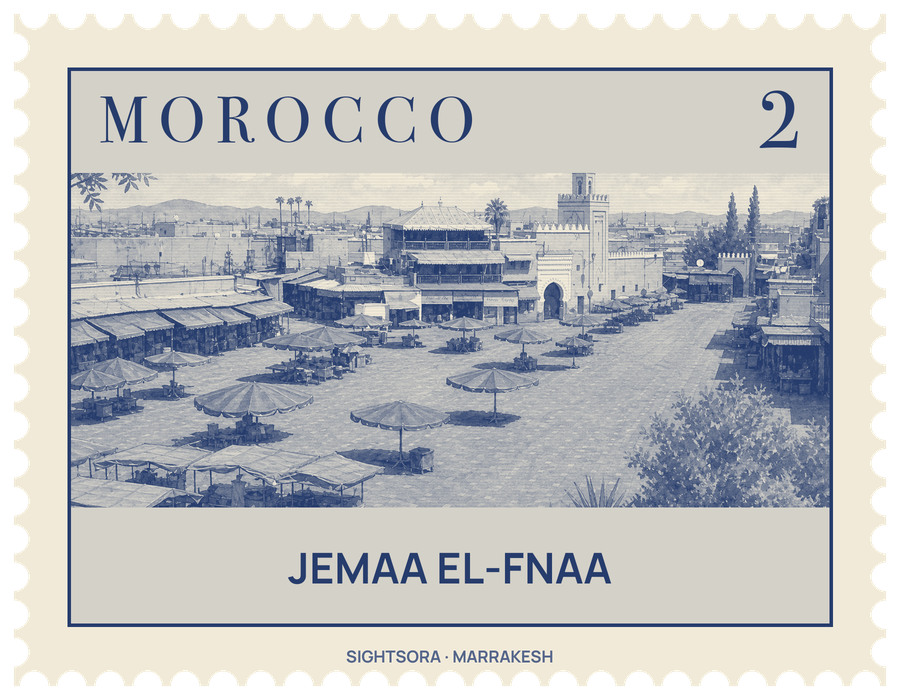
By day it belongs to orange juice stalls, water sellers carrying leather water-bags and brass cups, snake charmers and young men with chained macaques, even though both animals are protected under Moroccan law. Later in the day the crowds thicken around storytellers, magicians, dancers and sellers of traditional medicines, and as darkness falls dozens of food stalls set up and the square is at its fullest.
The square has been the city's main public space since Marrakesh was young. The Almoravids founded the city in 1070, and a large open ground for markets grew up beside their stone fortress, the Ksar el-Hajjar, which stood just north of the present Kutubiyya Mosque. Facing the royal palace gate, the square became the stage for public executions, military parades and festivals, and later for a traditional market, fantasia displays and evening entertainment, much as it is used today.
Historians favour an explanation for the name that points to a building that was never finished. The Saadian sultan Ahmad al-Mansur, who ruled from 1578 to 1603, set out to raise a great congregational mosque at its centre but abandoned it part-way, probably in the face of plague; its ruins were taken over by market stalls. The 17th-century chronicler Abderrahman as-Sa'idi wrote that the mosque was meant to be called the Mosque of Tranquility but became known, with popular irony, as the mosque of ruin. Its outline is thought to survive in the Souk Jdid, a modern block of shops just north of the food stalls.
One side of the square opens into the Marrakesh souk, which serves both everyday local needs and visitors; hotels, gardens and café terraces line the other sides, and narrow lanes lead off into the medina. Protection began early: in 1922 the government of the day passed the first laws to safeguard the square as a cultural space. Concern for its storytellers and musicians, threatened by economic pressure, inspired UNESCO's programme for masterpieces of oral and intangible heritage, and the square was among those proclaimed in 2001 and entered on UNESCO's intangible heritage list in 2008.