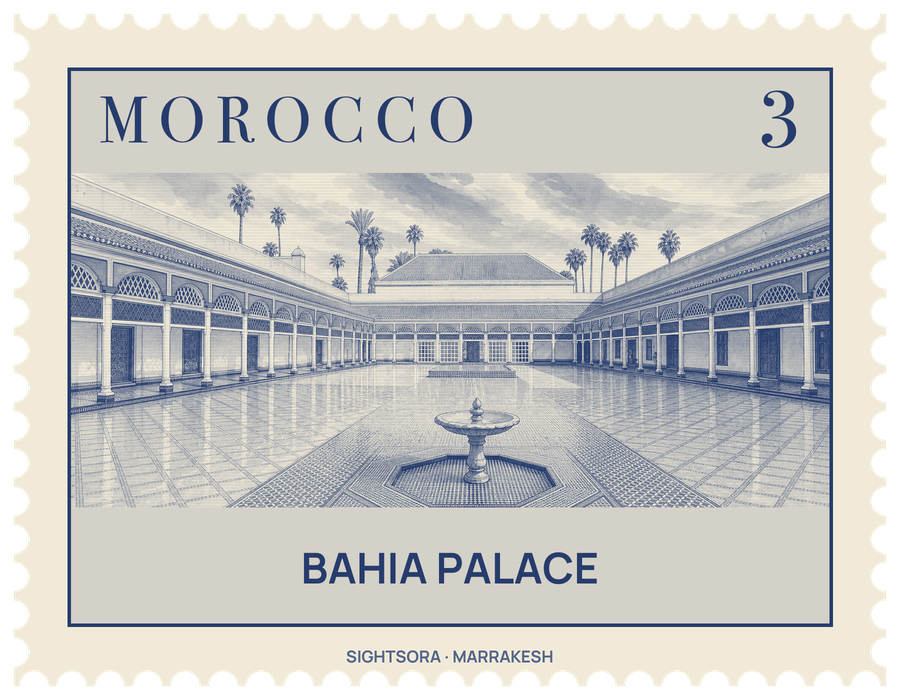
It has no single plan: it grew piece by piece as land came up for purchase, all on one level, and its fame rests on its decoration, above all the cedar ceilings painted with bright floral patterns.
The first part was built in the 1860s by Si Musa, grand vizier under Sultan Muhammad ibn Abd al-Rahman; inscriptions in the rooms of his Grand Riad date them to 1866–7. His son Ba Ahmed, grand vizier to the young Sultan Abdelaziz and the real ruler of Morocco from 1894 until his death in 1900, enlarged it into a true palace, with most of the southern wings, the Grand Courtyard and a private park reached by a bridge over the street. The architect was Muhammad ibn Makki al-Misfiwi of Safi. The name al-Bahia, "the Brilliant", is said to have been that of Ba Ahmed's favourite wife.
After Ba Ahmed died the palace passed to the crown and was looted within hours on the sultan's orders. Madani el-Glaoui took it over in 1908 and added an upper floor to some parts, and from 1912, under the French Protectorate, Lyautey lived here as resident-general. After independence it served King Mohammed V before passing to the Ministry of Culture, which opened it to visitors.
Visitors enter through a horseshoe-arched gate and walk down a long garden path to the palace. The Small Riad, a square garden quartered by paths and ringed by decorated rooms, includes Ba Ahmed's council chamber. Beyond it, the Grand Courtyard of 1896–7 is the most striking space: 50 by 30 meters, paved with Italian Carrara marble and framed by a colourful wooden gallery that opens onto some 80 rooms thought to have housed the harem, with a grand hall at its east end carrying some of the finest painted ceilings in the building. To the north, the Grand Riad of Si Musa's time still has trees planted in the 19th century.
The Ministry of Culture describes four main courtyards, each different, set with fountains and gardens, along with a Moorish bath and treasure rooms. Throughout, walls carry carved stucco with Arabic inscriptions, geometric patterns and muqarnas, and floors are laid with marble and zellij. Ba Ahmed brought the materials from across Morocco: Tetouan supplied the tiles, the Middle Atlas the cedar and Meknes the marble, worked by craftsmen from all over the country.