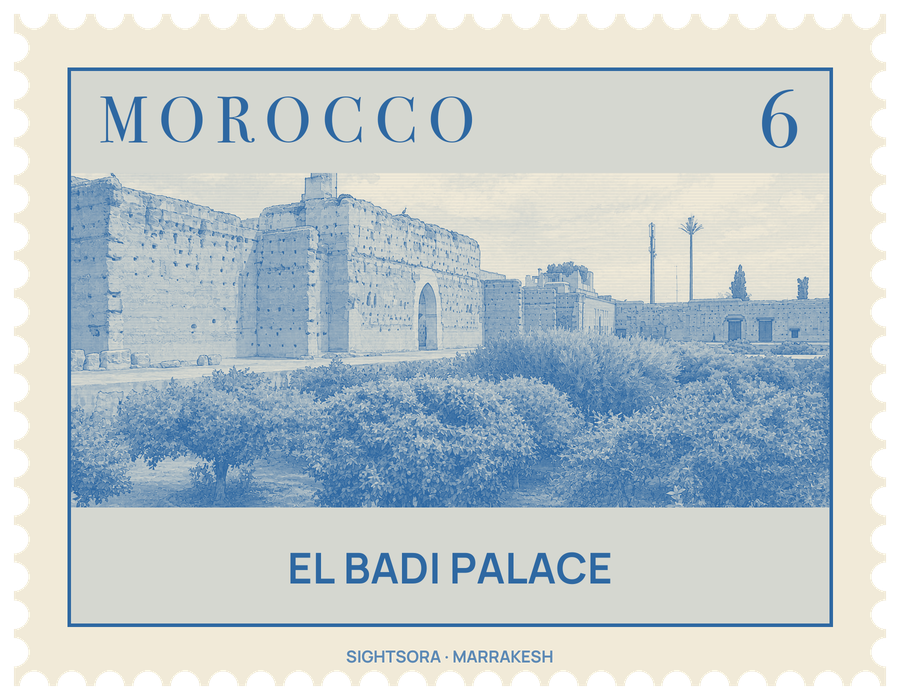
Its name, el-Badi', usually rendered "the Incomparable", is among the ninety-nine names Islam gives to God. Work started in December 1578, a few months after al-Mansur came to the throne following the Battle of the Three Kings, and he went on adding to its decoration until his death in 1603.
The palace was paid for largely by the Portuguese ransom after that battle and by the Saadian sugar trade with Europe. Artisans came from many regions, Europe among them, and materials from far abroad: marble columns made in Italy, said to have been bought from Italian merchants for their weight in sugar, and lime and plaster from Timbuktu. Floors were laid in marble and zellij, ceilings and capitals gilded, and walls covered in carved stucco with inscriptions, with gold and onyx among the finishes.
After al-Mansur the palace was left to decay. The Alawi sultan Moulay Isma'il, who would not let ambassadors see it in its poor state, ordered it stripped in 1707-08, and its marble and decoration went into his new palace and capital at Meknes; Saadian pieces, probably from El Badi, turn up in buildings across Morocco. The ruins served for a time as grazing ground and a home for owls.
The heart of the site is the courtyard, which measures 135 by 110 metres; a pool 90.4 metres long runs down its middle, and four great sunken gardens, rediscovered by excavation, lie symmetrically around it, a riad garden on a grand scale. A pavilion stood on each side. The western one, the Qubbat al-Khamsiniya, was the throne hall, and its remains still include a zellij-covered water basin; the eastern pavilion is gone, but the underground water channels beneath it show. Visitors can also enter a zellij-paved annex on the north side that may have lodged foreign ambassadors, and see the partly excavated bathhouse behind the southern pavilion.
The complex also serves as an exhibition space. Its best-known piece is a carved Almoravid pulpit of the 12th century, the minbar made for the Kutubiyya Mosque, and further galleries were opened in 2018.