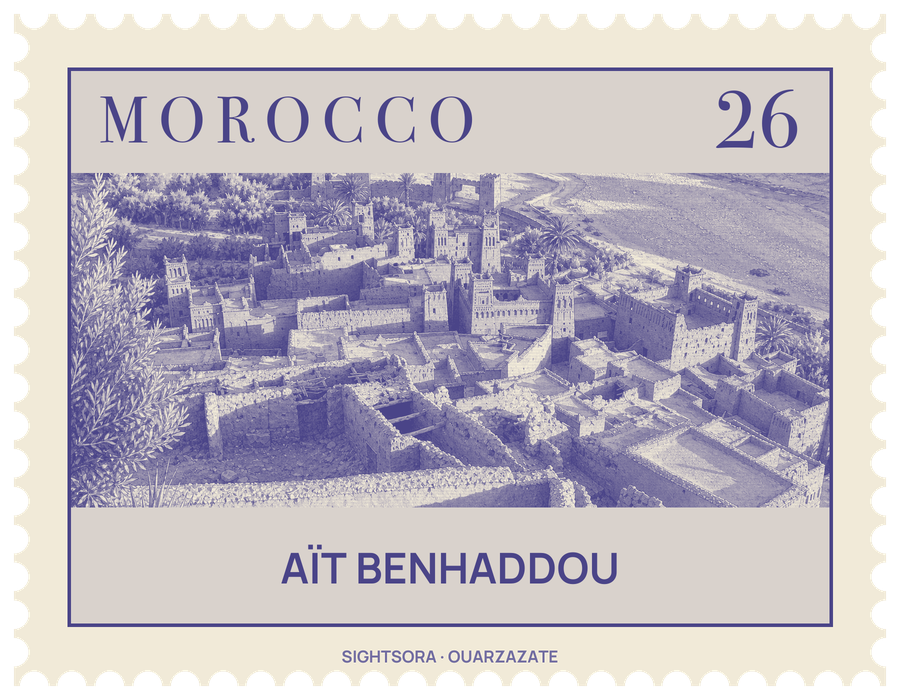
Its houses, towers and walls are built entirely of rammed earth, adobe, clay brick and wood, and the whole ksar is seen as a fine example of Moroccan earthen architecture. UNESCO added it to the World Heritage list in 1987.
The hill has been fortified since the Almoravid period in the 11th century, because a major trans-Saharan caravan road ran up the Ounila Valley toward the Tizi n'Tichka pass, one of the few ways across the Atlas Mountains between Marrakech and the Dra'a Valley. None of the present buildings is thought to be older than the 17th century, but they were raised with the same techniques used for centuries before. As the valley lost its strategic value in the 20th century, most families moved to the modern village across the river, and only a few still live inside the old ksar.
Within a defensive wall with corner towers and a gate, the village packs together homes of every size, from modest houses to tall tower-houses whose upper parts carry geometric decoration. There is also a mosque, a caravanserai, several kasbahs and a marabout shrine, that of Sidi Ali or Amer, along with a public square and both a Muslim and a Jewish cemetery. At the top of the hill stand the remains of a large fortified granary, an agadir, looking down over the ksar.
The walls are mostly a mix of earth and straw that rain wears away, so buildings of this kind can start to crumble within a few decades once they are left empty. At Aït Benhaddou the taller buildings use rammed earth up to the first floor and lighter adobe above to ease the load on the walls. UNESCO credits the ksar with keeping its authentic layout and materials, since repairs still use traditional methods and avoid concrete; a local committee looks after the site.
Restoration was helped along by the film industry. Productions shot here range from The Man Who Would Be King (1975) and The Living Daylights (1987) to The Last Temptation of Christ (1988) and Queen of the Desert (2015), and the village also appears in episodes of Game of Thrones.
Getting there
A pedestrian bridge, completed in 2011, crosses the Ounila River from the modern village to the old ksar.