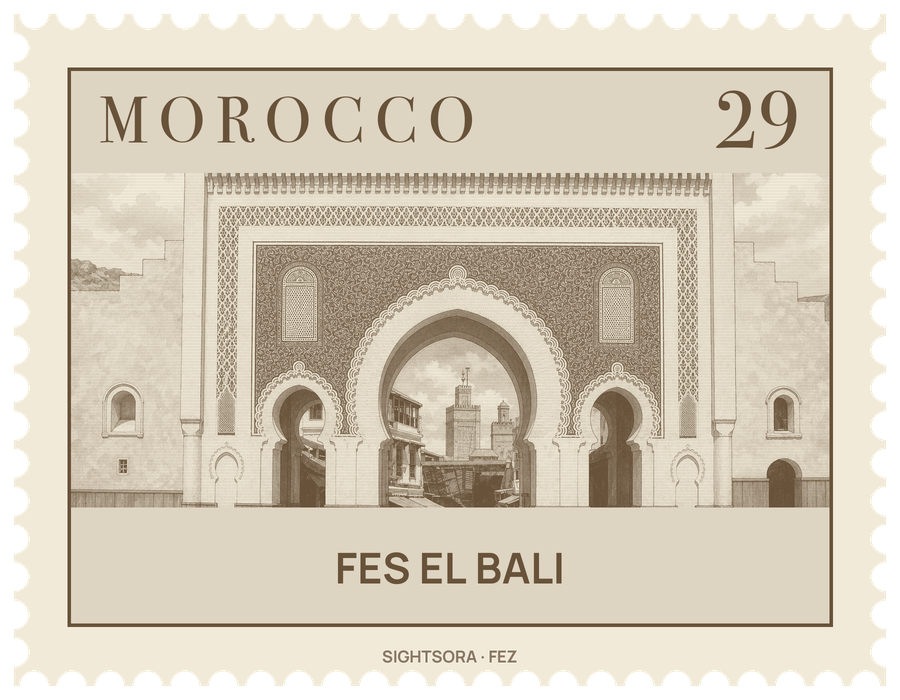
Its narrow lanes cannot take cars, which makes it a car-free urban area of roughly 300 hectares. Together with neighbouring Fes Jdid it makes up the historic medina, a UNESCO World Heritage Site since 1981.
The city began as two towns on opposite banks of the river. Idris ibn Abdallah founded the first on the right bank in 789, and his son Idris II founded his own capital on the other side in 809; the two grew up separately until the Almoravids united them in the 11th century. Both drew refugees, first from Cordoba and later from Kairouan. The city is still divided between the Qarawiyyin Quarter on the western bank and the Andalusian Quarter on the eastern. When the Marinids made Fez their capital in 1276 and built a new town outside the walls, the original city came to be called Fes el-Bali in contrast.
At the centre stands the Qarawiyyin, a mosque and university that traditional accounts trace to Fatima al-Fihri, a refugee from Kairouan, in 859. Her sister is traditionally credited with founding the Mosque of the Andalusians across the river in the same year. The Saadians later added ornate ablution pavilions to the courtyard of the Qarawiyyin. The Marinids gave the city the first true madrasas in Morocco, among them the Bou Inania, Al-Attarin and Sahrij madrasas, which are among the most notable monuments in the city.
The old city is laid out around its gates and its great mosques. The main souk streets run from the main gates, among them Bab Mahrouk, Bab Guissa and Bab Ftouh, toward the Qarawiyyin and, to a lesser degree, the Mosque of the Andalusians and the Zawiya of Moulay Idris II, and most of the funduqs, the old merchants' inns, line these streets. The lanes branching off them, called derbs, lead into residential neighbourhoods and often end in dead ends, so most visitors keep to the main commercial routes. Neighbourhood names still recall old trades, from el-Kettanin, the textile merchants, to es-Sagha, the moneychangers, and el-Fekharin, the potters.
Beyond the mosques, the landmarks include the Chouara Tanneries, the Funduq al-Najjarin, which holds the Nejjarine Museum of Wooden Arts and Crafts, and historic mansions such as the Dar Moqri and Dar Glaoui in the al-'Uyun district, once a quarter of gardens and wealthy estates. At the western end, near the well-known Bab Bou Jeloud gate, the Kasbah an-Nouar survives on the north side of Place Bou Jeloud, along with the Almohad-built Bou Jeloud Mosque. On the hills above the walls stand the Saadian forts of Borj Nord, which houses a Museum of Arms, and Borj Sud, built in the late 16th century to keep the city under watch. Between the old city and Fes Jdid, Moulay Hasan I built a walled corridor in the late 19th century where the royals laid out the Jnan Sbil Gardens and built the Dar Batha palace.
Getting there
The one main road into Fes el Bali follows the river from the south to Place R'cif, near the centre of the old city, and carries public transport.