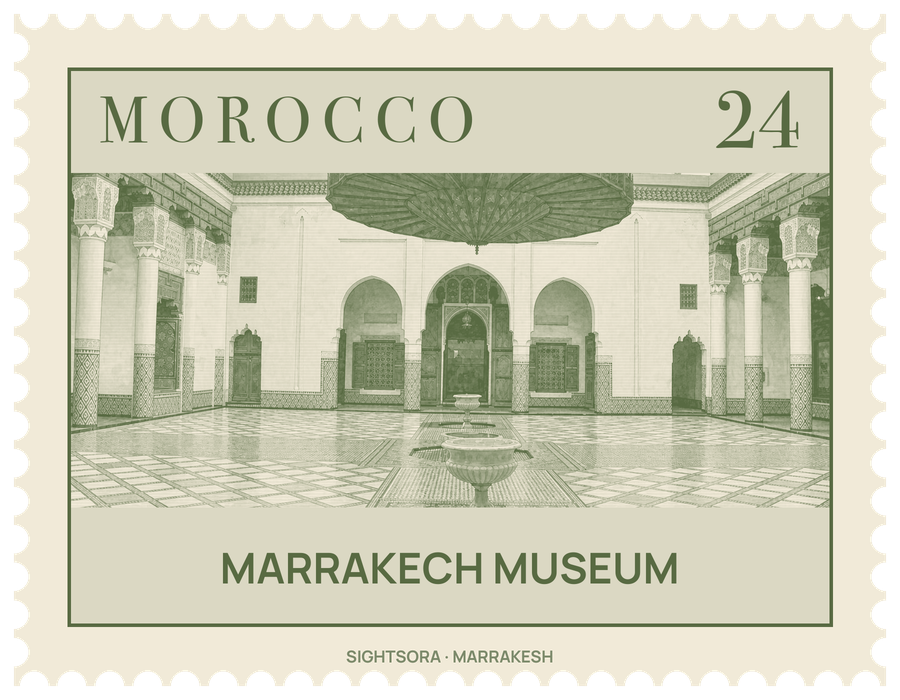
Its great central courtyard, once an open riad garden with trees, is now paved and roofed, with fountains at the centre and galleries and wall fountains around it covered in colourful zellij and painted, carved cedar. Hanging over the middle of the courtyard is a huge brass chandelier cut into geometric and arabesque patterns.
Mehdi al-Mnebhi had the palace built in the early 1900s; a qaid from the Mnabha tribe, he served as war minister to Sultan Moulay Abdelaziz from 1900 to 1908. While he was away as ambassador in London, the family of Pasha Thami El Glaoui took the house. After independence in 1956 it passed to the state, became a girls' school in 1965, and, after years of neglect, was restored by the Omar Benjelloun Foundation and opened as a museum in 1997.
Rooms off the courtyard keep more fine woodwork and stucco, with painted wooden ceilings, and the palace's own kitchens and hammam, with its domed and vaulted chambers, are used for exhibitions of contemporary art and other themes. The permanent collection gathers traditional objects from across Morocco and its communities: weapons and carpets, costumes, Fez pottery, Berber jewellery and Jewish liturgical objects, along with pieces such as a 19th-century saddle and a kummiya dagger.