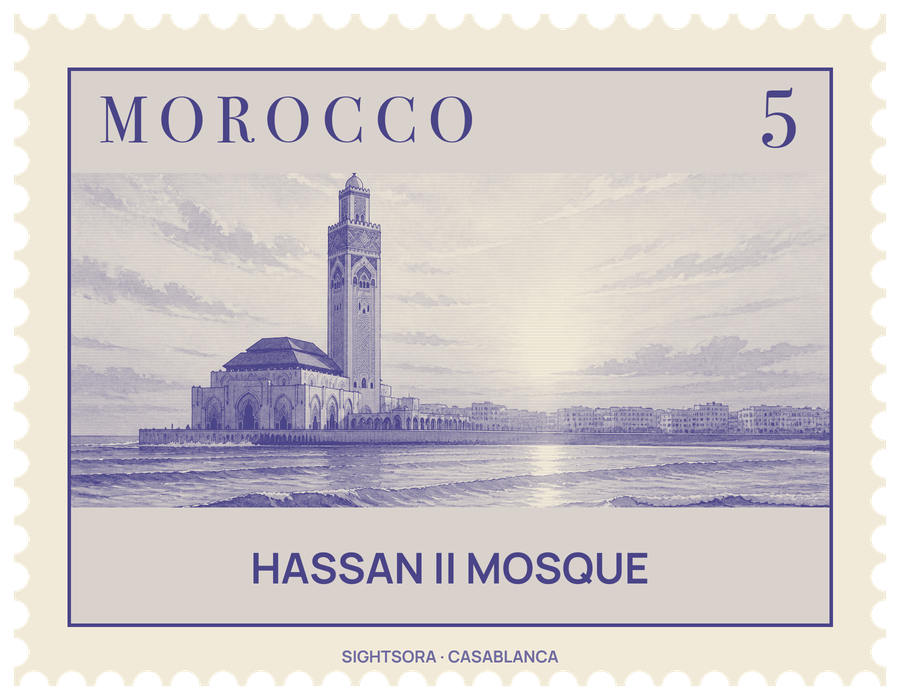
Its square minaret, roughly 200 metres high and faced in marble and green tilework, carries a laser at its top whose beam, with a range of 30 km, points towards Mecca. The 9-hectare complex sits between the harbour and the El Hank Lighthouse.
King Hassan II announced the project in 1980, saying he wanted a mosque on the water so that the faithful could look out on God's sky and ocean. The French architect Michel Pinseau designed it and the Bouygues group built it; work began on 12 July 1986 and the mosque was inaugurated on 30 August 1993, on the eve of the anniversary of the Prophet's birth. Much of the money came from a public subscription, with some twelve million people giving and each receiving a receipt and certificate.
The prayer hall, covering some 2 hectares, is a rectangle of 200 by 100 metres divided into three naves, the central one rising to 40 metres under a run of domes hung with Murano glass chandeliers. Mezzanine galleries with carved dark wood furnishings line both sides, and its doors are worked electrically. The roof slides open, filling the hall with sunlight by day and opening it to the night sky on clear evenings; it weighs 1,100 tons and opens in five minutes. Inside the hall, the mosque can hold 25,000 worshippers, and the surrounding plazas another 80,000.
Nearly all the materials came from Morocco: cedar from the Middle Atlas, marble from Agadir and granite from Tafraoute, apart from a number of Italian columns of white granite and the glass chandeliers. Thousands of Moroccan artisans spent years on the carved plaster, painted and sculpted cedar ceilings, muqarnas, zellige, marble, tadelakt and copperwork that cover the building, and the Hassan II Mosque Foundation presents the mosque as a showcase of traditional Moroccan craft.
Around the prayer hall the complex includes a madrasa built in a semi-circle, a large public hammam and ablution hall in the basement where tadelakt lines the baths, conference halls, a library and 41 decorated fountains in the courtyard. A museum shows pieces of traditional Moroccan art along with architectural elements made for the mosque but never used, among them carved stucco, painted wooden ceilings and zellij panels.
Getting there
The nearest railway station is Casa-Port, about a 20-minute walk from the mosque.