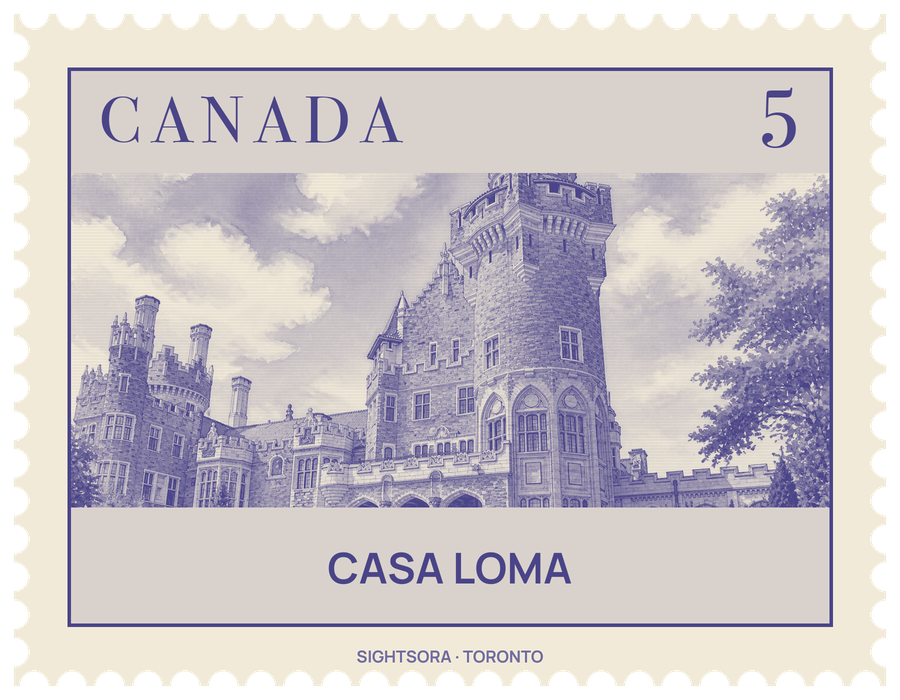
From its height the house looks down the slope and along Spadina Avenue towards the centre of the city. The financier Sir Henry Pellatt had it built between 1911 and 1914 to designs by E. J. Lennox, the architect of several other Toronto landmarks; it took 299 workers three years and is now a historic house museum.
Pellatt's fortune did not last. The First World War stopped construction, and in the slump that followed the city raised the property taxes so steeply that he sold off much of the art and furniture and moved out in 1923, after less than ten years in the house. The city took the building in 1924 over unpaid taxes. For a short spell in the late 1920s it ran as a luxury hotel, and a dance band that played there later found fame as the Casa Loma Orchestra under Glen Gray. From 1937 a Kiwanis Club ran the mansion as a tourist attraction, saving it from demolition, and during the Second World War the stables were quietly used to research and build sonar devices for hunting U-boats.
The house was planned with 98 rooms and equipped with an elevator, an oven large enough to roast an ox, a central vacuum, passages for pipe organs and, in Pellatt's office on the ground floor, two secret passages; the swimming pool and the basement bowling lanes were never finished. The showpiece is the Oak Room, first called the Napoleon Drawing Room, panelled in carved wood that took three artisans three years and topped by an ornate plaster ceiling by Italian craftsmen. The Conservatory, with a fountain at one end, was built to display plants, and the Round Room under the tower has doors and windows that curve to match its walls.
Pellatt rose from rifleman to commanding officer of his regiment, the Queen's Own Rifles of Canada, and its museum, brought here in 1970, fills much of the unfinished third floor with records and artifacts going back to 1860. The second floor holds a Girl Guide exhibit, a nod to Lady Pellatt, who often welcomed the Guides to the house. A tunnel runs from the mansion to the Hunting Lodge and the stables, where the stalls still carry the horses' names, and five acres of gardens surround the house.
The mansion's look has made it a regular film location, standing in for the X-Mansion in X-Men and appearing in productions such as Chicago, Scott Pilgrim vs. the World and Crimson Peak.
Getting there
Casa Loma stands on Austin Terrace at Spadina Road, above Davenport Road. Two stations on the Yonge-University subway line are close by: Dupont and St. Clair West.