The museum gives its holdings as 18 million artworks, cultural objects and specimens, shown in 40 gallery and exhibition spaces. It was founded on April 16, 1912, and the Duke of Connaught, then governor general, opened it to the public on 19 March 1914. For much of its history it was run by the University of Toronto, its neighbour, until it became an independent agency of the Ontario government in 1968.
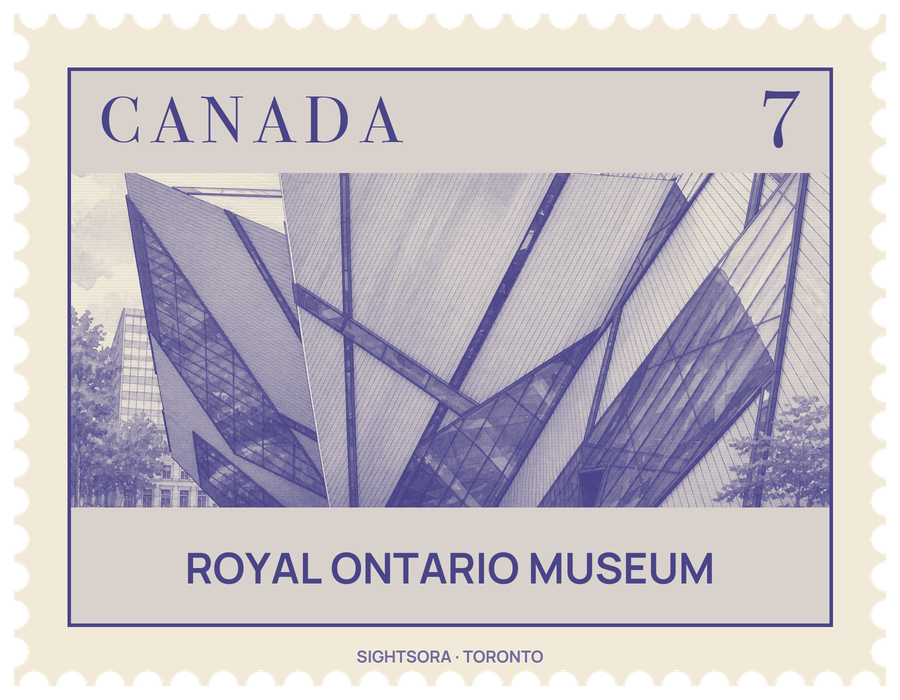
The complex is a layering of eras. The original 1914 building, designed by Frank Darling and John A. Pearson, mixes Italianate and Neo-Romanesque styles with heavy arched windows. The east wing facing Queen's Park opened in 1933 in a neo-Byzantine manner, and its entrance rotunda has a ceiling of gold glass mosaic set with animals, real and mythical, and symbols of early civilizations. The angular addition on Bloor Street, the Michael Lee-Chin Crystal by Daniel Libeskind, opened in 2007; clad in a quarter glass and three-quarters aluminium, it divided opinion from the start, and its main lobby is a three-storey atrium.
The natural history galleries fill the second floor. In the dinosaur galleries stand complete skeletons such as Gordo, a Barosaurus, and the type specimen of the crested hadrosaur Parasaurolophus walkeri, joined in 2025 by the armoured ankylosaur Zuul. Next door, the Reed Gallery, given over to the Age of Mammals, follows life after the dinosaurs, including an American mastodon found near Welland in southern Ontario. Dawn of Life traces early evolution through Canadian fossil sites like the Burgess Shale and Mistaken Point, and the museum holds more than 150,000 Burgess Shale fossils. Earth's Treasures, the Teck suite of mineral galleries, shows almost 3,000 minerals, gems and meteorites, among them pieces of the Tagish Lake meteorite. In the Bat Cave, visitors walk through a reconstruction of St. Clair Cave in Jamaica, and the Life in Crisis gallery displays endangered and lost species, from a white rhinoceros to the skeleton of a dodo.
The world culture galleries spread over the first, third and fourth levels. Ancient Egypt is represented by mummy cases, canopic jars, the gilded sarcophagus and mummy of Djedmaatesankh, a temple musician in Thebes, and a Book of the Dead scroll 7 metres long. The Wirth Gallery of the Middle East holds plastered skulls from the Levant and the Striding Lion relief from Nebuchadnezzar II's palace in Babylon. In the Chinese galleries, the Bishop White Gallery shows Yuan dynasty temple wall paintings and carved wooden bodhisattvas, while the architecture gallery holds the tomb of General Zu Dashou and a reconstructed palace building from Beijing's Forbidden City.
Elsewhere, the First Peoples gallery, named for Daphne Cockwell, brings together more than 1,000 artifacts, and the central staircase beside it winds around Nisga'a and Haida crest poles. The Samuel European Galleries trace decorative arts from the medieval period to the 20th century through period rooms and collections of arms and armour, including a suit of plate armour made for William Herbert, 1st Earl of Pembroke. The costume and textile gallery, named for Patricia Harris, changes its fragile pieces often, and the Roloff Beny Gallery hosts the museum's contemporary art exhibitions.
Getting there
Museum subway station takes its name from the ROM, and its platforms are decorated to echo the collection; the station's northwestern entrance leads straight into the museum.