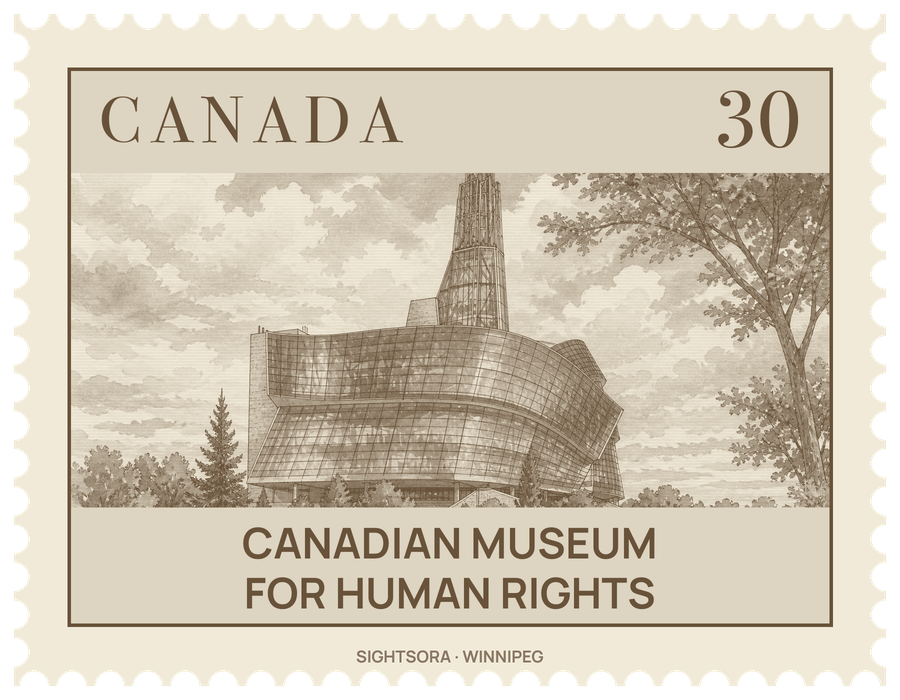
It is a national museum, created in 2008 when Parliament amended the Museums Act, and the first national museum in Canada sited outside the National Capital Region; it opened in September 2014. Its stated purpose is to explore human rights with particular, though not exclusive, reference to Canada, and its galleries draw on human rights stories both Canadian and international.
The idea came from Izzy Asper, a Canadian lawyer, politician and media founder, who hoped students from all over Canada would come here to learn about human rights. He died suddenly in 2003 on his way to announce the design competition, and his daughter Gail Asper carried the project forward. The competition drew 100 entries from 21 countries and was won by the Albuquerque architect Antoine Predock. On 3 July 2010 Queen Elizabeth II unveiled the cornerstone, set in Manitoba Tyndall stone and holding a stone she chose from Runnymede, the English meadow linked to the sealing of the Magna Carta in 1215.
Predock conceived the building as a journey. Visitors go in through its "roots", descending into the earth, then pass through the Great Hall and a sequence of large spaces linked by ramps of backlit alabaster, including the Hall of Hope, before climbing to the Tower of Hope. He drew on Canadian landscapes, ice, clouds, the northern lights and First Nations peoples, describing a white dove's wings wrapped around a mountain of Tyndall limestone 450 million years old. On the ground floor are visitor services, a shop and a restaurant, and the Garden of Contemplation sets still pools among black Mongolian basalt. The ground beneath is layered with history: excavations on the museum grounds between 2008 and 2012 recovered more than 400,000 artifacts, some as old as 1100 CE, and during the foundation work medicine bags made by elders at Thunderbird House were placed in the holes for the piles as a sign of respect for the earth.
The museum opened with 10 core galleries. Canadian Journeys, the largest, covers residential schools, missing and murdered Indigenous women, the forced relocation of Inuit, the Chinese head tax, the Underground Railroad, the Komagata Maru and the Winnipeg General Strike. Another gallery examines the Holocaust and the other genocides Canada recognizes: the Holodomor, the Armenian and Rwandan genocides, and the Bosnian ethnic cleansing. Indigenous issues run through every gallery and are central in the Indigenous Perspectives gallery. Reclaiming Power and Place looks at how two Indigenous artists from Winnipeg answer the call for justice for Indigenous women and Two-Spirit people, with the red dress as its central symbol; one of its co-creators is the Red River Métis artist Jaime Black-Morsette. On the fifth floor, the Carte International Reference Centre serves as the museum's library.