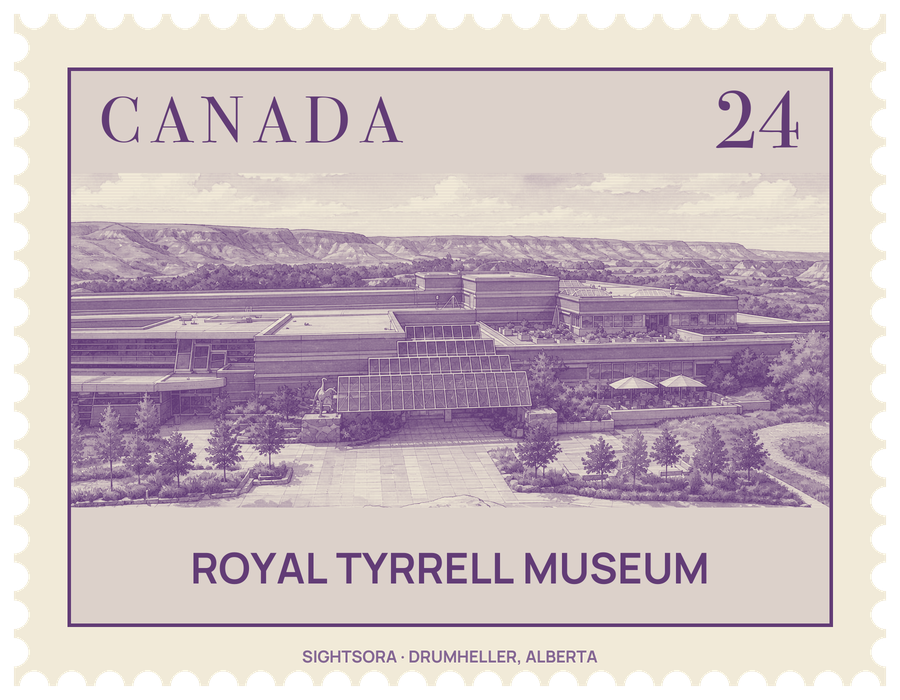
It is both a museum and a research institution, and its collection holds over 160,000 catalogued fossils, more than 350 of them holotypes. About 800 of them are on permanent display; most of the rest serve the museum's research into the geological and palaeontological history of Alberta.
The museum takes its name from Joseph Burr Tyrrell, a geologist with the Geological Survey of Canada who came across the first reported dinosaur fossil in the Red Deer River valley in 1884 while he was looking for coal seams. Alberta's government announced the project in 1981, and the Tyrrell Museum of Palaeontology opened on 25 September 1985 under its first director, David Baird. Queen Elizabeth II granted it the title "royal" in 1990. The building, by the Calgary firm BCW Architects with Doug Craig as lead architect, was designed to sit comfortably in the surrounding badlands, and it was enlarged in 2003 and again in 2019.
Several galleries follow geological time, among them Palaeozoic Era, Terrestrial Palaeozoic, Cretaceous Alberta and the Cenozoic Gallery. In Cretaceous Alberta, a diorama shows a pack of Albertosaurus based on 22 specimens from an Alberta bonebed, a nod to Tyrrell, who discovered that dinosaur. The Burgess Shale exhibit focuses on a single fossil deposit, and Grounds for Discovery shows finds turned up by commercial and industrial digging, including a Borealopelta uncovered by workers in the Athabasca oil sands.
Dinosaur Hall holds more than thirty mounted dinosaur skeletons, among them Albertosaurus, Camarasaurus, Triceratops and a Tyrannosaurus called Black Beauty. Triassic Giants, dedicated to the former curator of marine reptiles Elizabeth Nicholls, houses a Shonisaurus. In the Preparation Lab visitors can watch technicians clean fossils for display or study, and the Cretaceous Garden grows living relatives of the plants that covered Alberta in the Cretaceous. The Learning Lounge, opened in 2019, adds hands-on displays on how dinosaurs ate and moved, along with a bronze Albertosaurus; the lobby mural The Story of Life is made of ten ceramic panels by Lorraine Malach.
Outside, the Badlands Interpretive Trail runs for 1.4 kilometres northeast of the building through the eroded hills, and museum staff lead guided tours of Midland Provincial Park. The museum also runs public bonebed excavation programs in the Drumheller area and keeps a permanent field station in Dinosaur Provincial Park.