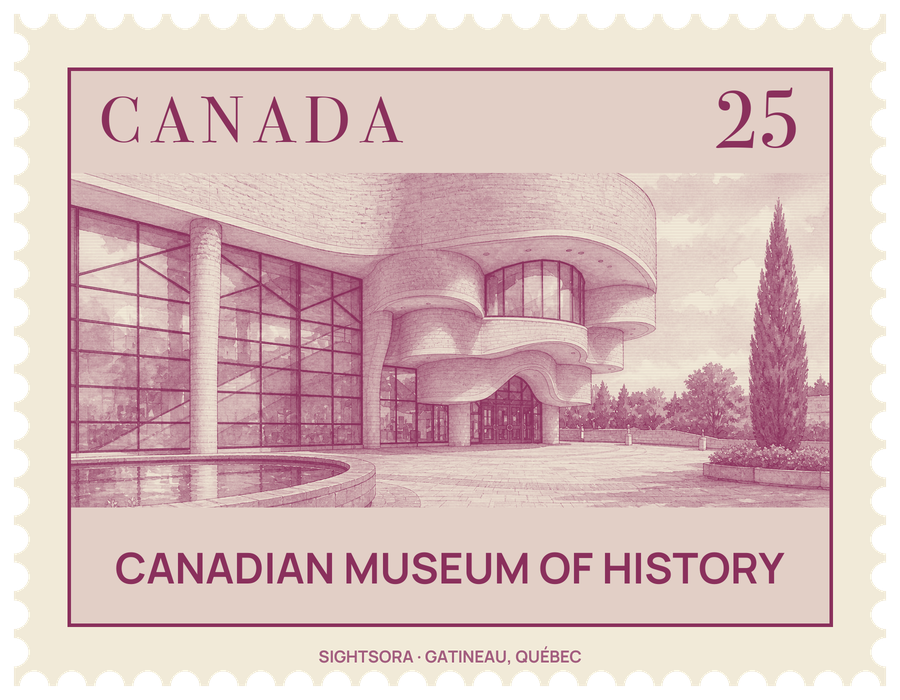
It is Canada's national museum of human history, anthropology and ethnology, with a collection of more than three million artifacts, documents and works of art. The museum acknowledges that its land is unceded traditional territory of the Algonquin Anishinabeg. Its roots go back to a museum the Geological Survey of Canada was authorized to open in 1856; it moved to this site in 1989 as the Canadian Museum of Civilization and took its present name in 2013.
Cardinal drew on the landscape left at the end of the last ice age. The cantilevered curatorial wing recalls rock outcrops of the Canadian Shield, while the glass front of the Grand Hall in the public wing suggests a glacier melting away, and its copper roof stands for plants returning to the land. Some forms evoke igloos, earth lodges and longhouses. The building is kept low so it does not block views of the river or of Parliament Hill, and a gap between the two wings frames the Hill from Laurier Street. A grand staircase leads down from the entrance plaza to gardens and a riverside park, where a path for walkers and cyclists continues north into Jacques-Cartier Park.
The Grand Hall is the centrepiece: with its totem poles and the North Coast House (Tsimshian), it holds From Time Immemorial — Tsimshian Prehistory and First Peoples of the Northwest Coast, two permanent exhibitions developed with Indigenous cultural specialists in the 1980s. Overhead, the domed ceiling carries Morning Star, a large mural by Alex Janvier added in 1993. Next to it, First Peoples Hall, opened in 2003, presents First Nations, Inuit and Métis peoples through more than 2,000 objects, in sections that include The Arrival of Strangers, Ways of Knowing and An Ancient Bond with the Land, shaped with an advisory committee of 15 Indigenous members.
Upstairs, Canadian History Hall, reopened in 2017, covers over 15,000 years in three galleries: Early Canada up to 1763, Colonial Canada from 1763 to 1914, and Modern Canada from 1914 on. They meet at a hub modelled on Chaudière Falls, with a floor image of Canada stitched from 121 satellite photos. Among more than 1,500 artifacts are an ivory carving of a human face 3,600 to 3,900 years old, James Wolfe's coat, the handcuffs Louis Riel wore before his execution, the hockey jersey of Maurice Richard, a T-shirt of Terry Fox and the sewing machine on which Joan O'Malley stitched the first Maple Leaf flag. St. Onuphrius Church, a Ukrainian church built on the Prairies in the early 20th century and later moved here, stands inside the hall at full size.
The Canadian Children's Museum, with over 3,000 square metres of hands-on space and an International Village, is designed for young visitors, and the Canadian Stamp Collection shows more than 3,000 stamps, every one issued in Canada since 1851, alongside objects that inspired them. The building also holds two theatres for live performance and a 295-seat 3D theatre.