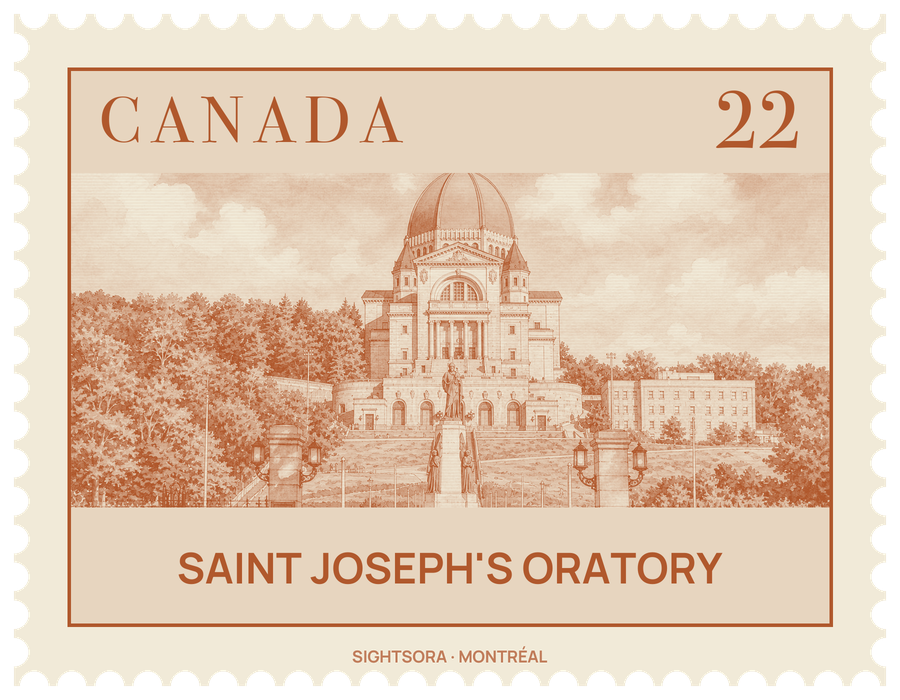
This national shrine and Roman Catholic minor basilica is dedicated to Saint Joseph and was founded in 1904 by Saint André Bessette, better known as Brother André, a Holy Cross religious brother whose fame as a healer spread far beyond Montreal. Building it took six decades and the work of numerous architects and thousands of labourers, and the result hides an Art Deco interior behind a Renaissance Revival front. Since 2004 it has been a National Historic Site of Canada.
Brother André began with a tiny chapel opposite Notre Dame College, only 4.5 by 5.5 metres, which was enlarged four times as his fame grew and was later moved about a hundred metres to make way for the basilica; it can still be visited. The architects Dalbé Viau and Alphonse Venne built the crypt church between 1914 and 1916 and raised the main building up to the roof between 1924 and 1927, before the Great Depression halted work. In 1937 the French-born monk Dom Paul Bellot redesigned the roof and dome, enlarging the dome and modelling it on that of Florence Cathedral; it was finished in 1941.
From the street, two parallel flights of 283 concrete steps climb to the basilica, with a central flight of 99 wooden steps set aside for pilgrims who climb on their knees. The front portico rests on four Corinthian columns 18 m tall, and the walls are faced with granite from quarries at Lac Mégantic in Quebec. The steps face northwest over the Montreal skyline, and around the summer solstice the setting sun lines up exactly with their centre line and with the main aisle inside, so people gather on them to watch the sunset and often applaud as the sun goes down.
Inside, the visit runs through several levels. The Crypt Church, which seats 1,000, has flattened concrete arches, oak woodwork and a Carrara marble statue of Joseph by A. Giacomini behind the altar. Between the crypt and the rock of the mountain lies the Art Deco Votive Chapel, built between 1946 and 1949, a long gallery glowing with some 10,000 candles and hung with crutches and canes left by pilgrims during Brother André's lifetime. His black marble tomb rests in a small semicircular room beside it, and an exhibition on level 6 traces his life with three life-size period rooms and his heart kept in a reliquary.
The Shrine above is a Latin cross 105 m long with seating for 2,028 people, decorated in Art Deco style with sculpture, bas-reliefs, mosaics and stained glass. Its double-shell dome has an outer shell 39 m across rising 97 m above the nave floor and an inner shell 26 m across, both made of thin concrete. A mural for the Oratory's 50th anniversary shows Saint Joseph as patron of workers, support of families and protector of the Church, with figures from the shrine's history and Montreal as it looked in 1954. Outside, a garden of the stations of the cross, laid out by the landscape architect Frederick G. Todd, sets 16 stations with 42 figures, each 3 m tall, among lawns, trees and flowers.