The museum describes itself as humanist and inclusive, open to every discipline from the visual arts to history and the sciences, and its galleries range from ancient objects to Inuit art, decorative arts and contemporary work. Its address is 1380, rue Sherbrooke Ouest.
It grew out of the Art Association of Montreal, founded in April 1860 by the Anglican bishop Francis Fulford to foster a taste for the fine arts in Montreal. For twenty years the association had no home, until the businessman Benaiah Gibb gave it 72 canvases, 4 bronzes and a building site on Phillips Square, where a gallery opened in 1879. Outgrowing that building, the association moved to the Golden Square Mile, where the brothers Edward and William Sutherland Maxwell designed a sober, majestic Beaux-Arts building; the Duke of Connaught opened it on December 9, 1912. The institution took its present name in 1949.
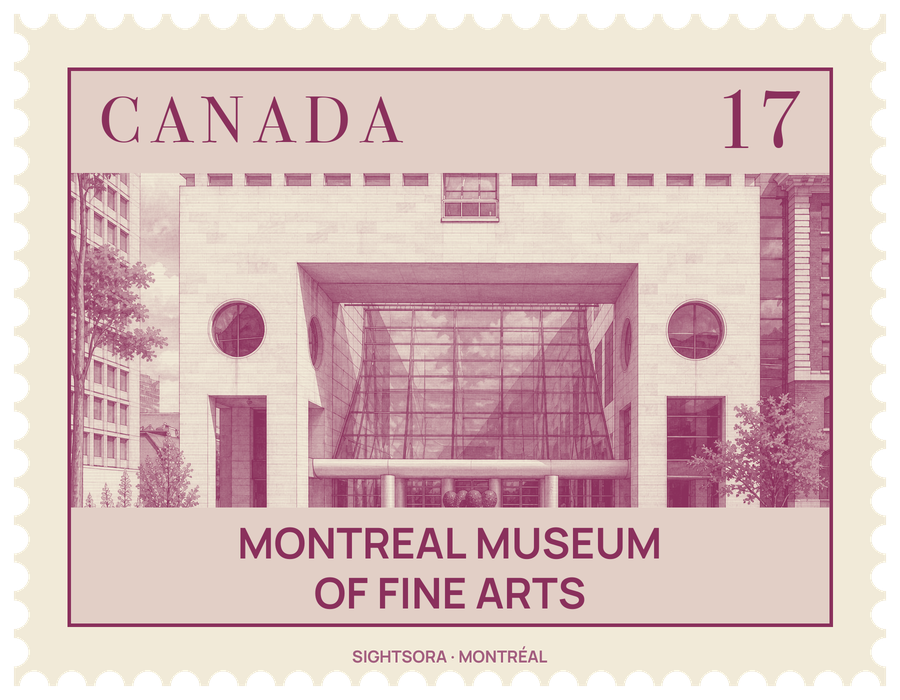
Today the original Maxwell building is the Michal and Renata Hornstein Pavilion. Across the street, the Jean-Noël Desmarais Pavilion, designed by Moshe Safdie and opened in 1991, keeps the old facade of the New Sherbrooke Apartments and holds modern and contemporary art along with the Arts of One World wing, whose 10 galleries hold over 1,200 pieces from all continents, dating from the 4th millennium BCE onward. The modernist Liliane and David M. Stewart Pavilion of 1976, by Fred Lebensold, is devoted to decorative arts and design: furniture, glass, silverware, textiles, ceramics and industrial design, much of it given by Liliane and David M. Stewart.
The Claire and Marc Bourgie Pavilion, opened in 2010, is the former Erskine and American United Church, a Romanesque Revival building of 1893–94 with Tiffany stained glass and a National Historic Site of Canada; Quebec and Canadian art now fills it. The newest building, the Pavilion for Peace named after Michal and Renata Hornstein, honoured in 2018 with a Governor General's Medal in Architecture, shows international art from early periods to modern times. The museum has more than doubled its space for Inuit art, whose collection of prints, textiles, sculpture, photography and video it has built since the 1950s, alongside work by First Nations and Métis artists.
Generous collectors shaped the holdings. Frederick Cleveland Morgan, unpaid curator of decorative arts from 1917 until 1962, added more than 7,000 pieces and turned the museum into an encyclopedic one; in 1959 Joseph Arthur Simard gave 3,000 Japanese incense boxes that had belonged to Georges Clemenceau; and Renata and Michal Hornstein donated works by old masters and large groups of drawings by Ferdinand Hodler. In 2024 the museum turned the streets bordering its pavilions, including Bishop Street and du Musée Avenue, into a renewed Sculpture Garden.