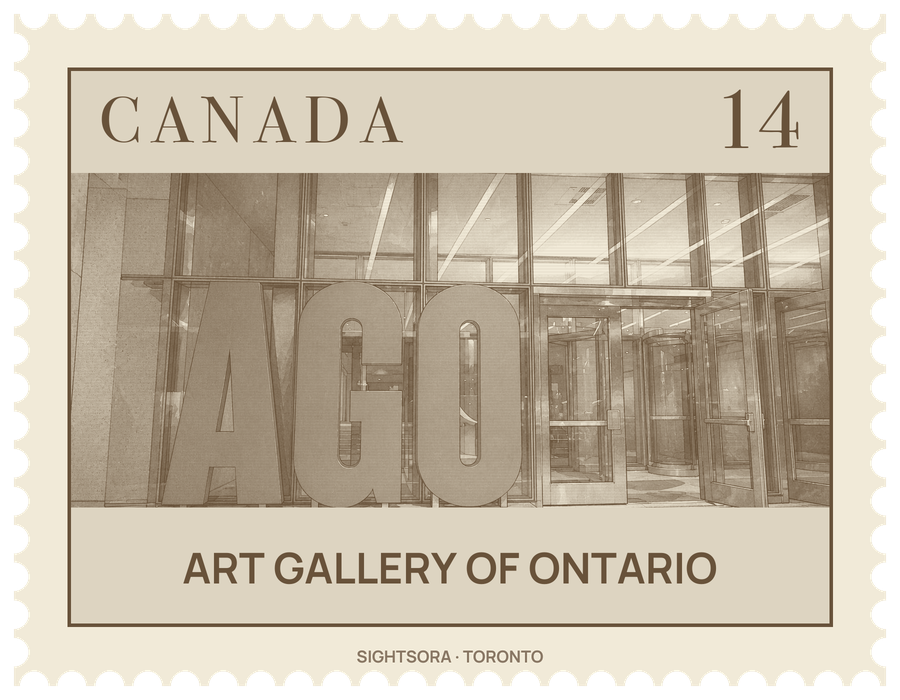
Private citizens set it up in 1900 under the name Art Museum of Toronto, and it took its present name in 1966 when it became the province's art museum. The complex covers 45,000 square metres, with 12,000 of them given over to galleries.
The museum's oldest part is The Grange, a Georgian-style manor of 1817 that Harriet Boulton Smith left to the gallery; it opened as the art museum in 1913 and is now a National Historic Site. Galleries were added to the north and west in stages through the 20th century, and between 2004 and 2008 the Toronto-born architect Frank Gehry tied the pieces together. Rather than a new building, he produced a restrained reworking: the Galleria Italia, a 200-metre wooden and glass gallery projecting over the Dundas Street sidewalk, a new glass roof over Walker Court with a spiral staircase, and a five-storey South Gallery block clad in glass and titanium, with a staircase spiralling out from its upper levels. Behind the museum, Grange Park is kept as a public park.
Canadian art fills much of the second floor. Kenneth Thomson's gift of nearly 650 Canadian works brought 250 pieces by Tom Thomson, 145 by Cornelius Krieghoff and 168 by David Milne, alongside the Group of Seven. In the McLean Centre for Indigenous & Canadian Art, works are hung by theme rather than date, so that Tom Thomson's The West Wind has been shown next to Anishinaabe pouches, and labels appear in English, French and Anishinaabemowin or Inuktitut. The Inuit collection includes thousands of sculptures, prints and drawings, 500 of them displayed in the Inuit Visible Storage Gallery, and Emily Carr's Church at Yuquot Village belongs to the Canadian collection.
On the ground floor, the European collection runs from about 1000 to 1900. Its centrepiece is Rubens's Massacre of the Innocents, part of the Thomson Collection of European Art, which also includes 130 ship models and a group of Gothic boxwood miniatures, tiny carved beads and altarpieces. Other highlights include works by Tintoretto, Bernini, Frans Hals, Rembrandt, Gainsborough and Pissarro.
Henry Moore gave the gallery 300 pieces, nearly his whole personal collection, in 1974, on condition that it build a space for them; the skylit Henry Moore Sculpture Centre, whose dimensions and colours he helped choose, is the result. The modern collection also takes in Picasso, Modigliani, Matisse and Giacometti, and the contemporary galleries in the upper floors of the south block show artists such as Gerhard Richter, Andy Warhol, Michael Snow and Brian Jungen. A permanent Infinity Mirror Room by Yayoi Kusama, Let's Survive Forever, opened in 2019.