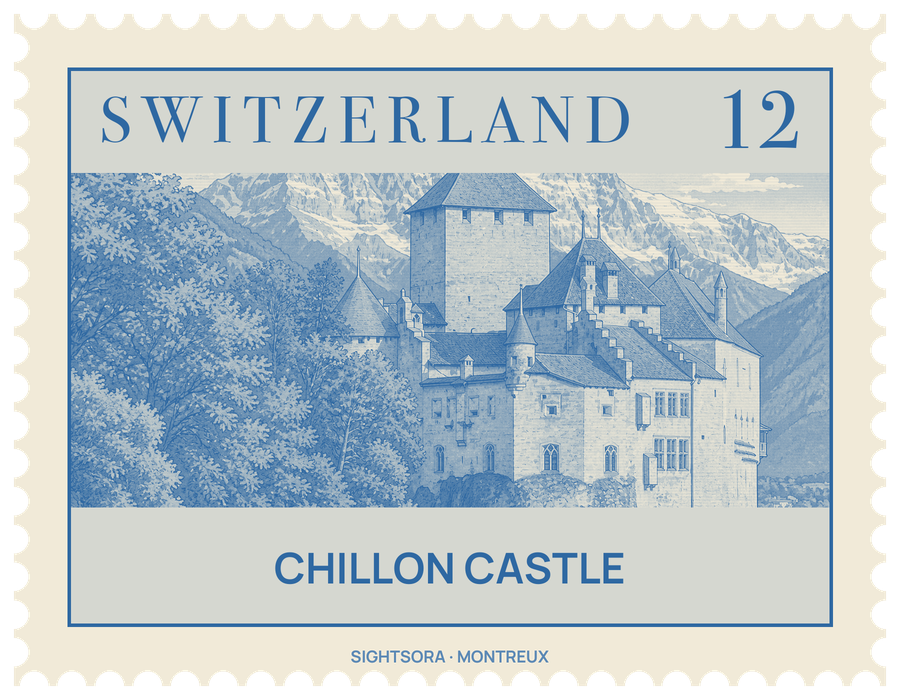
The site was chosen for control: it commands the passage between the Vaud Riviera and the Rhône valley, the quick road to Italy, and looks across the water to the Savoyard coast, so a garrison here could hold the route and charge a toll on it. The name is thought to come from a Waldensian word for a flat stone or platform; as Castrum Quilonis it is recorded from 1195. Today the canton of Vaud owns the castle, which Switzerland classifies as a Cultural Property of National Significance.
The oldest part is a square keep of the 11th century, raised to control the route that ran from Burgundy towards the Great Saint Bernard Pass. By 1150, a charter shows the castle in the hands of the House of Savoy, and from the middle of that century the Counts of Savoy used it as a summer residence, keeping a fleet of ships on the lake. Count Peter II enlarged it greatly in 1248 and 1266–7, and its distinctive windows were added at that time by Master James of Saint George.
The Savoy rulers also kept prisoners here. The best known was François de Bonivard, a Genevan monk and historian, prior of St. Victor in Geneva, who was locked up for six years from 1530 until a Bernese army took the castle in 1536 and freed every prisoner. Chillon then became the seat of the Bernese bailiff until 1798, when Vaud drove out the Bernese authorities; under the French occupation that followed it served as a store for munitions and weapons.
At the end of the 19th century the castle was restored in one of the first projects to rebuild a monument faithfully with the help of archaeology and history, led by the Association for the Restoration of Chillon, founded in 1887. The work was held up as a model, and the German Emperor William II asked about it when planning the reconstruction of Haut-Koenigsbourg. The visit leads through three courtyards, four great halls and several bedrooms, among them the Camera domini, used by the Duke of Savoy and painted with 14th-century murals, alongside recreated interiors such as the grand bedroom, the hall and the cave stores. The castle also puts on exhibitions, workshops and events through the year.
From the late 18th century Chillon drew writers, Lord Byron, Victor Hugo, Mary Shelley, Jean-Jacques Rousseau, Gustave Flaubert and Alexandre Dumas among them. Bonivard's story inspired Byron, after a visit, to write his 1816 poem The Prisoner of Chillon, and the poet is said to have carved his name on a pillar in the dungeon. Eugène Delacroix painted the prisoner from the poem, Gustave Courbet painted the castle several times while living in exile nearby, and Henry James sent his heroine there in Daisy Miller.