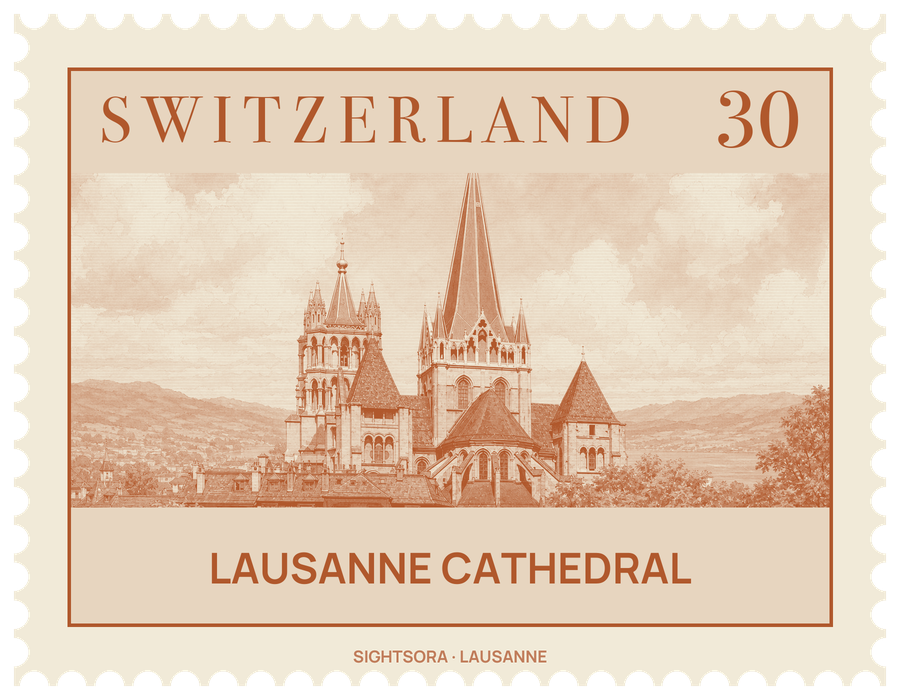
After two earlier master masons, Jean Cotereel built most of the present structure, with a porch and two towers: one became the belfry while the other was never finished. In 1275 it was dedicated to the Virgin Mary by Pope Gregory X, with King Rudolph I of Germany among those present.
The rose window of the south transept was drawn in his sketchbook by the medieval architect Villard de Honnecourt around 1220–1230. With the Reformation, which reached Lausanne largely from nearby Geneva, the church passed to Protestant use: in 1536 a new liturgical area was set up in the nave and the colourful interior decoration was covered. Eugène Viollet-le-Duc directed later restorations, and in the 20th century the painted interior and a painted portal on the south side were restored.
The great organ, inaugurated in December 2003 after ten years of design work, was built by the American firm Fisk and has 7000 pipes, two consoles, five manuals and a pedalboard; it combines the Classical, French Symphonic, Baroque and German Romantic organ styles in one instrument and weighs 40 tons. Seven bells hang on two levels of the belfry, the oldest from 1493 and the newest from 1898, and they still mark the hours. The cathedral also holds the fourteenth-century tomb of Otto de Grandson, a Savoyard knight who served King Edward I of England as envoy and was his friend for life, who commanded England's knights during the siege of Acre in 1291.
Since 1405 the city has kept a lookout in the bell tower without a break. Each night the lookout calls the hour towards the four points of the compass with the words "C'est le guet, il a sonné", followed by the hour; the post was created to warn of fire and has become a tradition. In 2021 Cassandre Berdoz was chosen as the first woman to serve as deputy lookout.