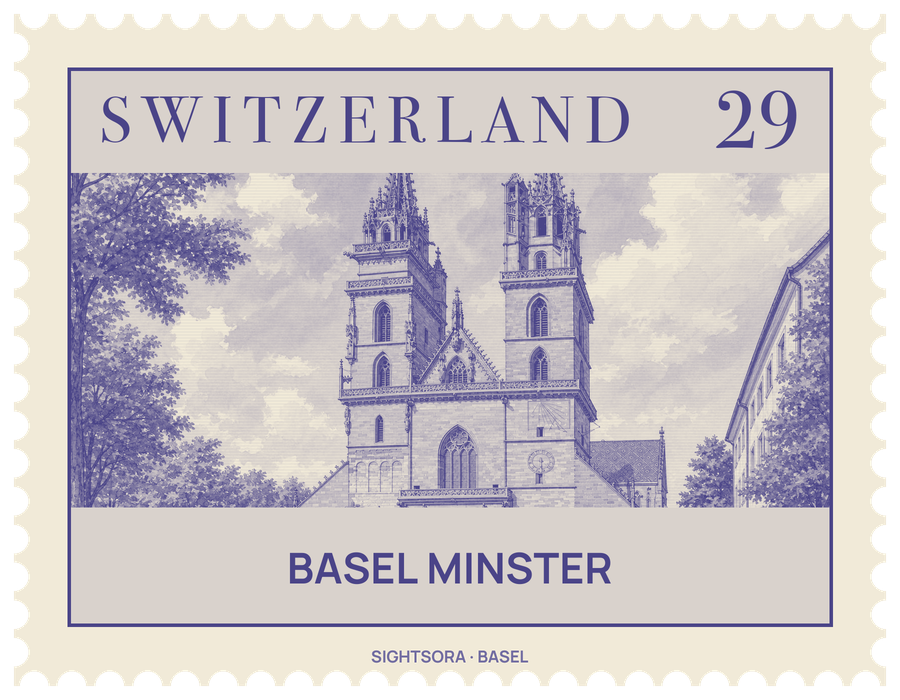
Built as a Roman Catholic cathedral in Romanesque and Gothic styles over the period from 1019 to 1500, it has been a Reformed Protestant church since the Reformation and is listed as a heritage site of national significance. The hill itself was a Celtic fortified town in the first century BC, and part of its Gallic wall was uncovered in 1970.
Most of what stands today is the late Romanesque church of the late 12th century, finished around 1225. The Basel earthquake of 1356 brought down five towers, the choir and several vaults, and Johannes Gmünd, who also worked on Freiburg Minster, rebuilt it; Ulrich von Ensingen, the architect of towers at Ulm and Strasbourg, extended the north tower from 1421, and Hans Nussdorf finished the south tower on 23 July 1500. The two cloisters were added in the 15th century. During the Reformation, on 9 February 1529, a crowd broke in and smashed the altars, crucifixes and images, and the cathedral became the city's main Reformed church.
The west front is flanked by the Georgsturm (64.2 m) to the north and the Martinsturm (62.7 m) to the south, named after Georg and Martin, the saints of knights, whose equestrian statues stand on pilasters beside the main entrance. The lower, paler part of the Georgsturm survives from the late 11th century, and a large painting of 1372 below it shows the knight Georg fighting a strikingly small dragon. Above the statue of Martin are a mechanical clock and a sundial. Both towers can be climbed by 242 steps, linked by a gallery past the belfry, for views across Basel towards the Jura Mountains and the Black Forest foothills; the stairs in the southern tower pass an old church clock from 1883.
At the main porch, the empty column between the doors once held a statue of the Virgin Mary, while the carved arches still show Abraham, kings and prophets, dancing angels and roses. To the left stand the founders, Emperor Henry II, shown young and beardless with a model of the church, and Empress Kunigunde; to the right, a smiling foolish virgin undresses before a seducer, the "Prince of this World", whose back crawls with toads and snakes, a group from around 1280. Inside, the choir passage holds the sarcophagus of Queen Anne of Habsburg, wife of King Rudolf of Habsburg, and her son Charles, and the stained glass by Franz Xaver Eggert dates from the 1850s. The church hosts regular services and concerts throughout the year.