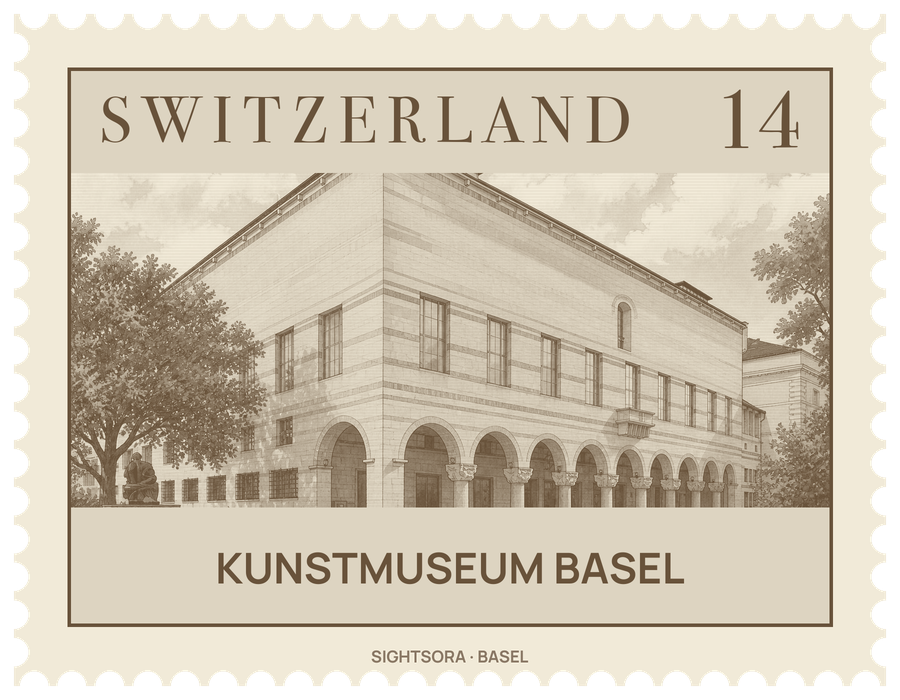
Its roots go back to the Amerbach Cabinet, a collection that included works by Hans Holbein and was purchased in 1661 jointly by the University and the city of Basel; in 1671 the city opened it to the public in the House zur Mücke near the Munster. The collection grew with the Faesch Museum, joined to it in 1823, and in 1936 moved into its present home, the main building designed by Paul Bonatz and Rudolf Christ. Switzerland lists the museum among its heritage sites of national significance.
Two strengths stand out: painting and drawing from the Upper Rhine between 1400 and 1600, and art from the 19th century to the present. The early rooms gather works by the Holbein family alongside Matthias Grünewald, Konrad Witz, Lucas Cranach the Elder, Martin Schongauer and Hans Baldung Grien, followed by Flemish and Dutch painting by Rubens, Rembrandt and Jan Brueghel the Elder. The 19th century brings Manet, Monet, Gauguin, Cézanne and van Gogh together with two Swiss painters, Ferdinand Hodler and Arnold Böcklin. For the 20th century the emphasis is on Cubism with Picasso, Braque and Juan Gris, and there are large groups of work by Paul Klee, Fernand Léger, Alberto Giacometti and Marc Chagall.
Contemporary art is represented by Joseph Beuys, Andy Warhol, Jasper Johns, Bruce Nauman, Georg Baselitz, Rosemarie Trockel, Robert Gober and many others. In 1939, under director George Schmidt, the museum acquired many works by German-Jewish artists whom the Nazi regime had branded degenerate, and these works still hang in the museum. In the front courtyard and arcade, Dan Flavin's Untitled (In memory of Urs Graf), installed in 1975, is a permanent outdoor work.
Across Dufourstrasse stands the new building by the local firm Christ & Gantenbein, completed in April 2016: an angled block faced with concrete bricks, built to the same height as the main museum and joined to it by an underpass. It added 2,750 square metres of galleries, bringing the total to nearly 10,000. The main building now shows art from the 15th century to 1950 and the new one later work, with temporary exhibitions on its upper floor. A third site, the Museum for Contemporary Art, has been housed since 1980 by the Rhine, in the St. Alban neighbourhood.