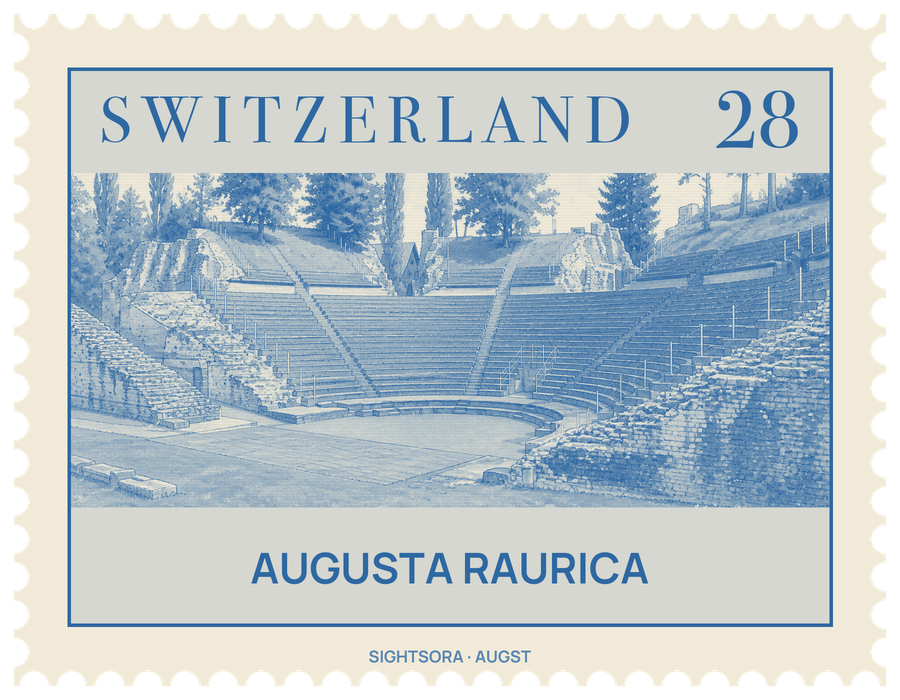
Lucius Munatius Plancus founded the colony around 44 BC near the Gallic Rauraci, but real settlement followed Augustus' conquest of the central Alps; the oldest find so far has been dated to 6 BC. By the 2nd century AD it had become a prosperous trading town of perhaps 20,000 people, known for exporting smoked pork and bacon across the empire.
The town sat on a plateau cut into a triangle by the Ergolz and Violen streams, its point facing the Rhine. Starting from the temple of Jupiter, planners laid out a grid of streets on gravel beds with gutters on both sides, forming blocks of around 50 by 60 metres, and the more important streets had covered walkways behind rows of columns. An earthquake damaged much of the town in 250 AD, and around 260 AD it was destroyed; the Romans then built the fortress of Castrum Rauracense on the Rhine, whose walls still partly stand.
Many buildings have been excavated and conserved and most can be visited. The great theatre, designed together with the temple facing it across the street as a single architectural whole, is the centrepiece, alongside the main forum with the temple of Jupiter, the basilica and the town council chamber. There are modest remains of an amphitheatre, parts of the aqueduct that brought water from Liestal, a taberna, a bakery, a potter's workshop, a tile kiln, sections of the sewer and a mysterious well shaft. Around 80 percent of the built-up area has still not been excavated, and a team of about 60 people works on uncovering, restoring and presenting the finds.
The Roman Museum tells the town's history and shows its most important finds, above all the silver treasure of Kaiseraugst, unearthed inside the fortress in 1961–1962 and probably once owned by a commander. Beside it a reconstructed Roman house shows domestic and working life. Switzerland lists the excavations, the late Roman fortress, the early Christian baptistery and the brick kiln at Liebrüti among its heritage sites of national significance.
Getting there
The site lies some 750 metres south of Kaiseraugst railway station, served by the S1 line of the Basel S-Bahn.