The couple set up their foundation in 1982 and the museum opened its doors on 18 October 1997 with 140 works of modern classics, 23 of them by Picasso. The collection, now some 400 works, follows their view of 20th-century art from Claude Monet, Vincent van Gogh and Paul Cézanne through Pablo Picasso to Andy Warhol, Roy Lichtenstein and Francis Bacon, and alongside the paintings stand about 25 tribal objects from Oceania, Africa and Alaska. It has kept growing in art made after 1950, with recent acquisitions including Gerhard Richter, Louise Bourgeois and Wolfgang Tillmans.
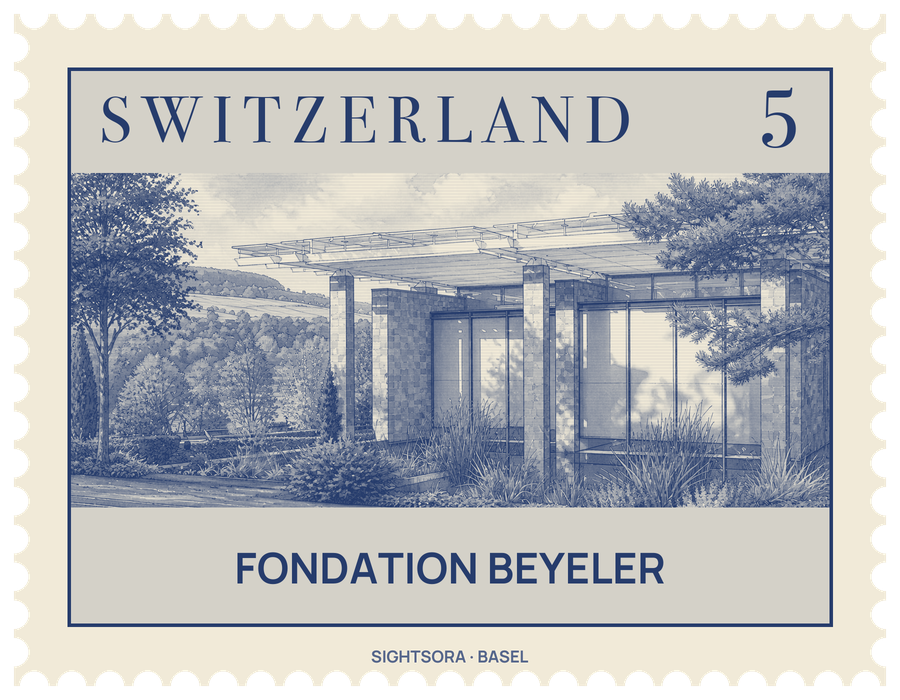
Piano's plan is defined by four walls of red porphyry from Patagonia, each 115 metres long and 7 metres apart, running north to south. On top of them rests a light glass roof, enamelled white underneath, that lets in northern light while keeping out the eastern and western sun, and on the long sides it reaches far beyond the walls to shade the glass façade. Through that façade the galleries look out over corn fields and the vines of the Tüllinger Hills. Ernst Beyeler wanted the building to be more than a museum: a small power plant where visitors would get their strength back. Opposite it, the late-Baroque Villa Berower holds the administration and a restaurant.
The foundation stages exhibitions of modern and contemporary art, about a third of the gallery space is set aside for special shows, and the park sometimes becomes part of the exhibition: in 1998 Christo and Jeanne-Claude wrapped 178 trees there and in the neighbouring Berower Park. In 2026 an expansion by Peter Zumthor was completed, adding three buildings: a gallery named after the Swiss entrepreneur Hansjörg Wyss, the Ammann Pavilion for performances, and the Erlen Torhaus office building. The landscaping that came with it, by Vogt Landschaftsarchitekten, roughly doubled the size of the park, so the museum today is an ensemble of modern and historic buildings in a garden setting.