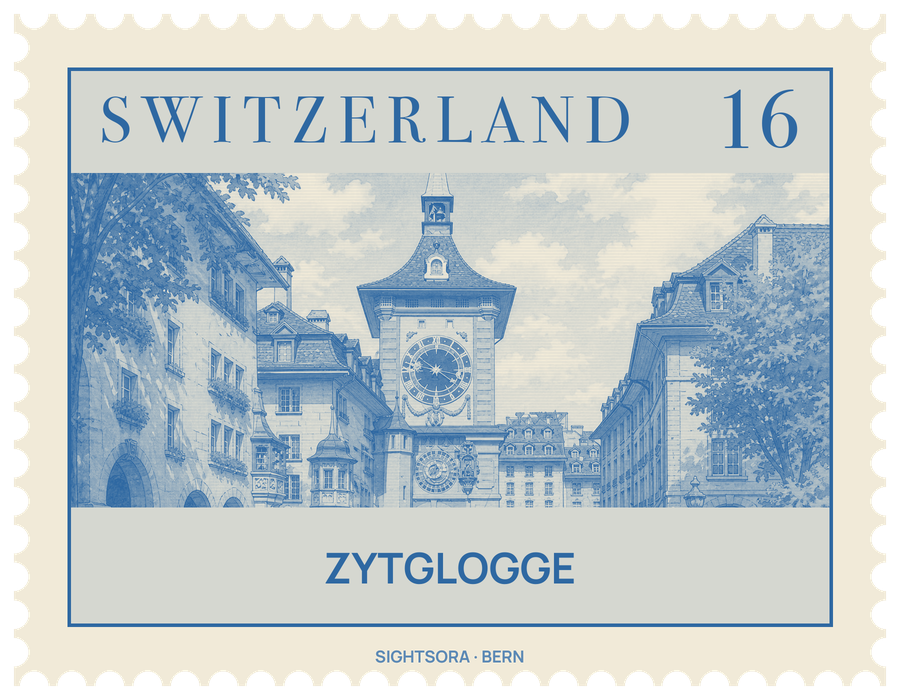
Its Bernese German name means "time bell", after the clock and the great bell fitted after the fire of 1405 gutted the building; the name first appears in records in 1413. Switzerland lists the tower among its heritage sites of national significance, and it stands within the Old City of Bern, which is on the UNESCO World Heritage list.
The tower began as a squat gate of 16 metres and was raised by 7 metres around 1270–1275 as the city spread west. Once the walls moved further out in 1344–1346, it held women prisoners, among them women convicted of relations with clergy. Kaspar Brunner rebuilt the clockwork in 1527–30, and the outline seen today goes back to a late Baroque renovation of 1770–1771 by Niklaus Hebler and Ludwig Emanuel Zehnder. A thorough restoration in 1981–1983 brought it back to that 1770 appearance. The whole structure rises 54.5 metres, with a red-tiled late Gothic spire above a plinth of alpine limestone and a sandstone shaft.
Both main façades carry large clock faces. On the east side, golden Roman numerals mark the hours and a small golden sun on the hour hand is mounted so that it always stays upright. The west face is set into the fresco "Beginning of Time", painted by Victor Surbek in 1929, in which Chronos sweeps down with his cape flying while an angel drives Adam and Eve out of Paradise below the dial.
High in the cupola hang the two bells. Johann Reber cast the great hour bell in 1405; it is 127 centimetres across and weighs 1,400 kilograms; on every full hour a gilded, bearded Chronos in armour, known locally as Hans von Thann, lifts his arm as a clockwork hammer strikes it. The wooden figure seen today was made in 1930, copying a Baroque predecessor. A smaller bell below sounds the quarters; it was cast in 1887 to replace a cracked one from 1486.
Lower down, the astronomical clock is laid out like an astrolabe. Its dial shows the night sky in black, dawn in deep blue and daylight in light blue, crossed by golden lines; a zodiac ring with a calendar, a moon dial showing the phase and a day-of-the-week display turn above it. A painted frieze over the clock shows Saturn, Jupiter, Mars, Venus and Mercury, each standing for a day and a planet. Since 1979 the empty interior of the tower has been open only on guided tours.