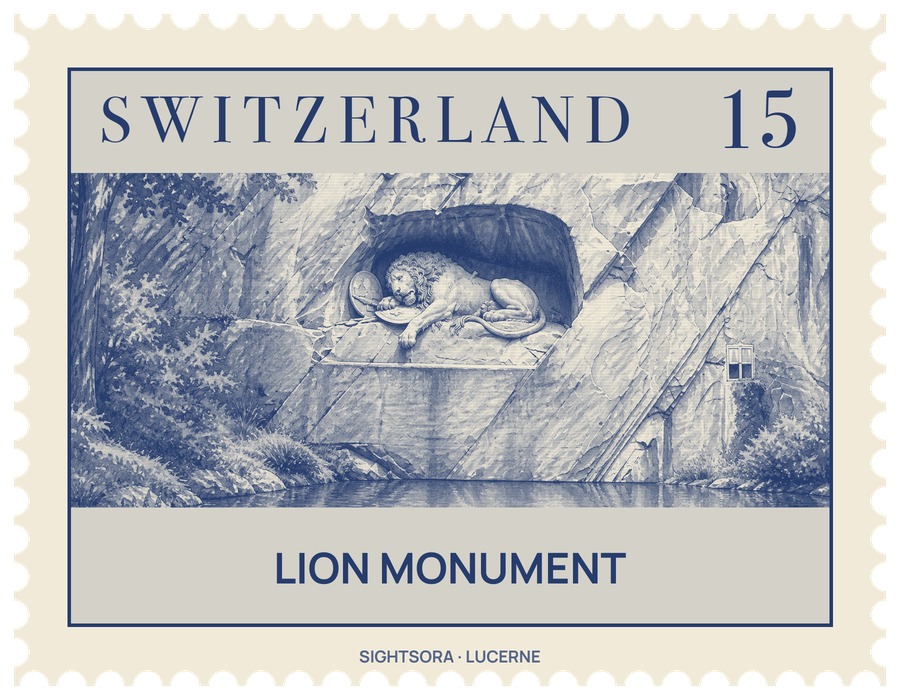
A spear is lodged in the lion's body, and its paw rests protectively on a shield bearing the French monarchy's fleur-de-lis; next to it lies a second shield with the arms of Switzerland. Above it runs the dedication Helvetiorum Fidei ac Virtuti, honouring the loyalty and bravery of the Swiss, and the inscription below lists the officers by name and gives the number of soldiers who died, DCCLX or 760, and of those who survived, CCCL or 350. The monument has been under Swiss monument protection since 2006.
It remembers the Swiss Guards killed on 10 August 1792, when the Tuileries Palace in Paris was stormed by revolutionaries. A Swiss regiment had served the French royal household since the early 17th century; that day the royal family was taken from the palace to shelter with the Legislative Assembly, and the guards, running short of ammunition, were overwhelmed. A note from the King ordering them to withdraw to their barracks survives, but it was only obeyed once their position could no longer be held. Many died in the fighting or were massacred after giving up.
The memorial was the idea of Karl Pfyffer von Altishofen, a Guards officer who was home on leave in Lucerne when the palace was attacked. His book on the regiment caused a stir in conservative circles, and from 1818 he raised money by public subscription, mostly from European royal houses, to pay for it. The monument was finished in 1821.
Its message was contested from the start. Swiss liberals objected to honouring men who had died for a foreign king and saw the lion as a symbol of a counter-revolutionary spirit; some threatened to saw off one of its paws. Mark Twain, writing in 1880, described the setting as part of its power: the lion lies in a low, sheer cliff with vines hanging down, and a clear stream trickles into a pond at its foot, where the carving is reflected among water-lilies, in a quiet nook of trees and grass.