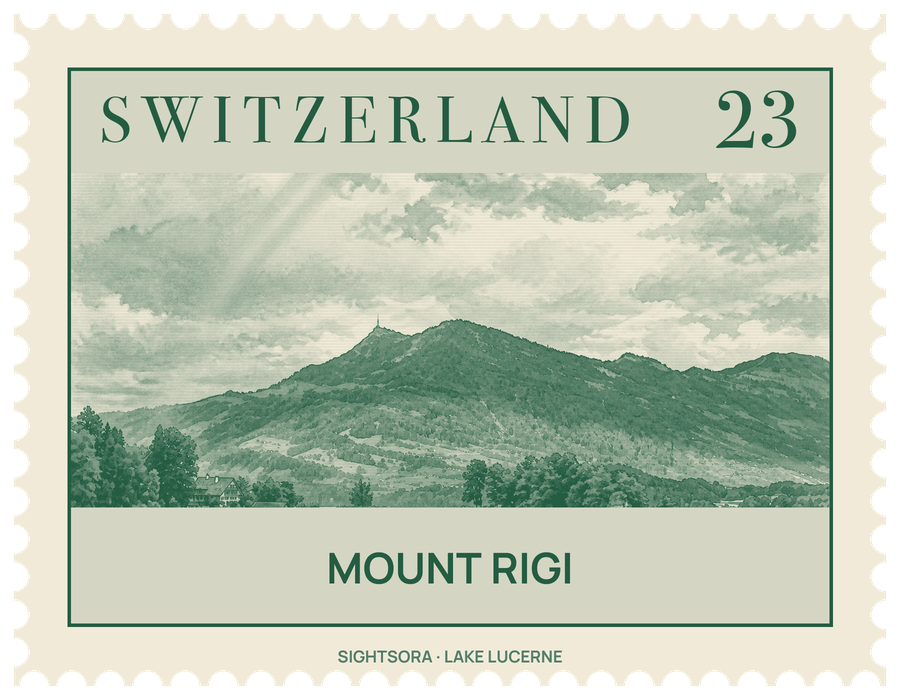
Marked viewpoints across the mountain open views of up to 150 km, and some 90 square kilometres of slopes are laced with walking trails, with public grilling spots along the way. In winter the mountain draws skiers and sledgers. Its name comes from Old High German for a band or stripe, after the horizontal rock ledges and strips of grass that wrap around it, though it has long been nicknamed the "Queen of the Mountains".
The Rigi drew pilgrims long before tourists. A chapel and hermitage were built at Rigi Kaltbad in 1585, and the pilgrimage chapel of Maria zum Schnee, opened at Rigi Klösterli in 1689, brought thousands of visitors a year. Goethe came in 1775, Queen Victoria rode up on horseback from Küssnacht in 1868, and Mark Twain wrote about his visit in A Tramp Abroad. J. M. W. Turner painted the mountain several times, including The Blue Rigi, Sunrise.
In the 19th century the mountain filled with grand hotels at Kaltbad, Kulm, Staffel, Scheidegg, Rigi-First and Klösterli, and the railway line from Vitznau up the mountain opened in 1871. The First World War ended that era and many of the hotels were later demolished or burned down. The various mountain railways were merged into RIGI BAHNEN AG in 1992, and a Mineral Bath & Spa designed by Mario Botta opened in 2012. Geologically the Rigi is not part of the Alps at all but belongs to the Swiss plateau, built mostly of molasse and conglomerate.
Getting there
The Rigi Railways climb to Rigi Kulm and to the resort of Rigi Kaltbad; the line from Vitznau has run since 1871. A gondola lift rises from Weggis, which boats reach from Lucerne, to Rigi Kaltbad, and from Kräbel, a stop on the Arth-Rigi-Bahn, a cable car climbs to Rigi-Scheidegg.