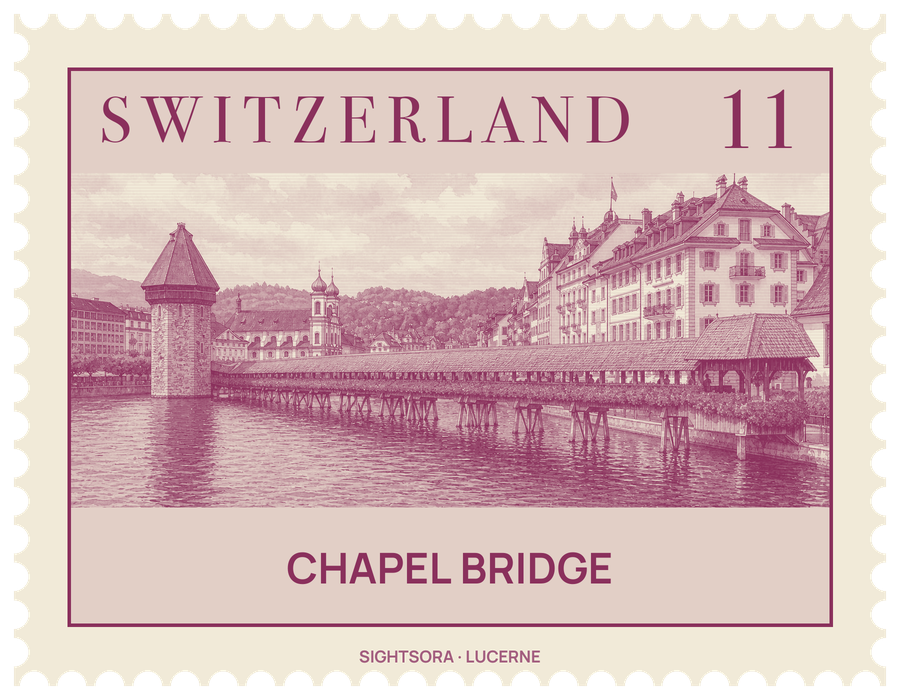
It was built around 1365 as part of the town's defences, joining the old town on the right bank to the new town on the left and guarding Lucerne against attack from the lake to the south. The bridge once ran for more than 270 metres; repeated shortening and the filling-in of the riverbanks have left it at 204.7 metres. Its structure is a series of strutted, triangulated trusses resting on trestles of piles driven into the riverbed, and it serves as the symbol of the city.
Beside the bridge stands the Wasserturm, an octagonal tower 34.5 metres tall whose name means a tower standing in the water. It is about 30 years older than the bridge and over the centuries has served as a prison, a torture chamber, a municipal archive and the town treasury.
Walking through, visitors pass under painted triangular panels set into the roof frame. They were painted in the 17th century by the local Catholic painter Hans Heinrich Wägmann, during the Counter-Reformation, and tell the history of Lucerne and its patron saints, from the life and death of St. Leger to the legends of St. Maurice. City councillors paid for individual panels and in return could add their coat of arms, and a caption explained each scene. Most of the boards are spruce, a few linden or maple. Lucerne's wooden bridges were alone in Europe in having such painted frames; besides the Kapellbrücke, the 16th-century Spreuerbrücke had them too, while the Hofbrücke is gone.
On 18 August 1993 a fire nearly destroyed the bridge, burning a large part of it along with two thirds of its paintings. Of 158 original panels, 147 had survived until then; afterwards the remains of 47 were recovered, and in the end 30 could be fully restored. The rebuilt bridge reopened on 14 April 1994.