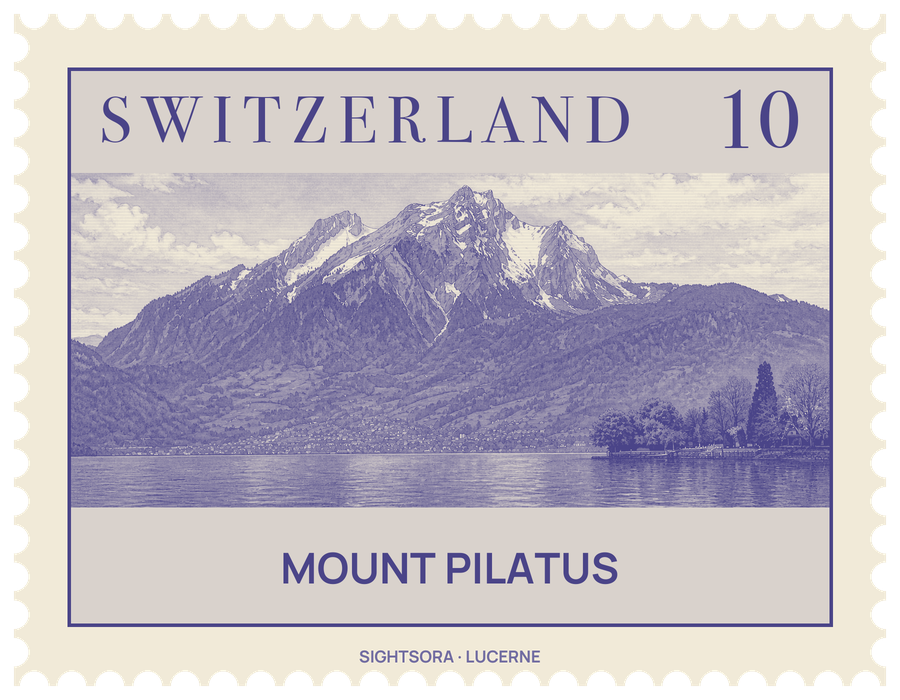
Its highest point is the Tomlishorn, at 2,128.5 metres, about 1.3 kilometres south-east of the station where the cog railway and the cable cars arrive. Two other summits sit right beside the station: the Esel, at 2,118 metres, just to the east, and the Oberhaupt, at 2,105 metres, to the west, where a fortified radar and weather stations stand closed to the public. The hotels of Pilatus Kulm are at the top, and Alpine ibex live on the mountain.
Several legends explain the name. One holds that Pontius Pilate was buried on the mountain; another says its outline resembles the belly of a big man, Pilate, lying on his back; a third derives it from pileatus, "cloud-topped". The list of people who have stood on the summit includes the naturalist Conrad Gessner, Arthur Schopenhauer in 1804, Julia Ward Howe in 1867, Queen Victoria and Theodore Roosevelt. The cog railway opened in 1889, and walkers who want to reach the outlying peaks, the Matthorn, Widderfeld or Klimsenhorn among them, need proper Alpine hiking equipment.
Getting there
There are two ways to the top: the cog railway from Alpnachstad, and the aerial panorama gondolas and cableways from Kriens. A popular circuit, the Golden Round Trip, combines them: a boat trip over Lake Lucerne from Lucerne to Alpnachstad, the cog railway up, the cableways and gondolas down to Kriens, and a trolleybus back to Lucerne.