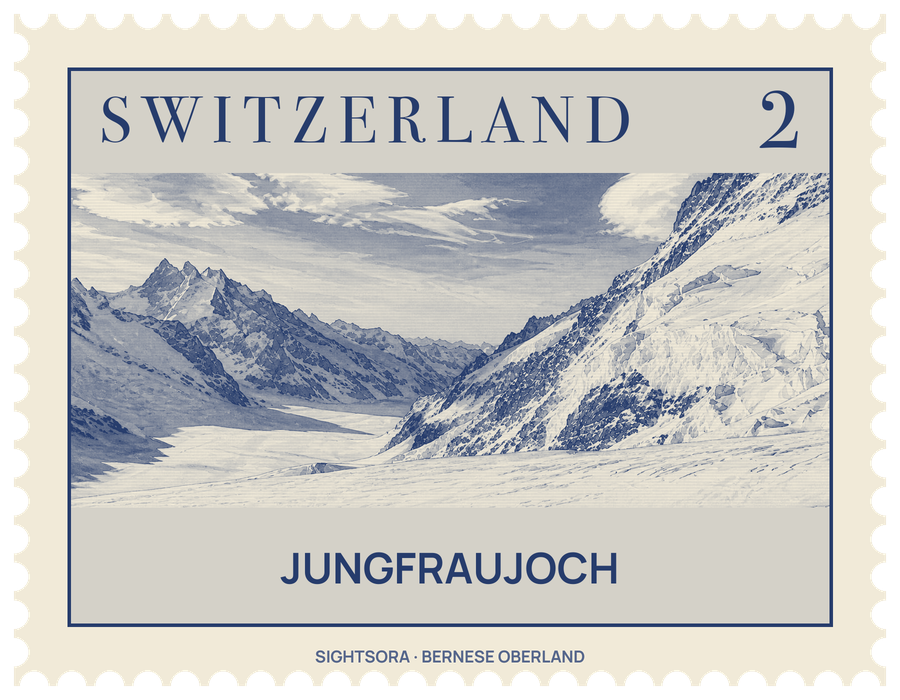
Its southern side is almost flat: the Jungfraufirn, one of the ice streams that feed the Aletsch Glacier. The northern side falls away nearly vertically, almost 3,000 metres down towards Interlaken. Bern lies to the north of the saddle and Valais to the south, it belongs to the Jungfrau-Aletsch area, and the ridge here is a major European watershed: meltwater from the north side ends up in the Rhine, and from the south side in the Rhone.
Visitors have been able to come up since 1912, when the Jungfrau Railway was completed. The idea belonged to Adolf Guyer-Zeller, who in 1893 imagined a line running all the way to the top of the Sphinx; the work was dogged by money shortages, bad weather and fatal accidents, the worst in 1908 when 30 tons of dynamite blew up, and the line in the end stopped at the saddle. From Kleine Scheidegg the train enters a tunnel of about 7 kilometres that runs through the Eiger and the Mönch, on gradients of up to 25%. It halts at Eigerwand, where a window some 8 metres long has been cut halfway up the Eiger's north face and passengers can step off for a few minutes to look out, and then at a second window over the Eismeer, the "Sea of Ice". The ride up takes about 50 minutes with both stops; the descent about 35.
The Jungfraujoch station lies at 3,454 metres, east of the saddle, and leads into the Top of Europe building with its panoramic restaurants, shops, exhibitions and post office. Several tunnels lead out onto the glacier, where secured trails cross the crevassed ice, most notably to the Mönchsjoch Hut; the standard climbing routes up the Jungfrau and the Mönch also start from here. A lift rises from the Jungfraujoch to the Sphinx Observatory, whose viewing platform stands at 3,572 metres; the building also houses one of the atmospheric research stations of the Global Atmosphere Watch. Almost everything built here, station included, is on the Valais side of the border, in the municipality of Fieschertal.
Long before the railway, the saddle was a mountaineers' prize. In July 1862 a party of six English climbers, among them Leslie Stephen, and six Swiss guides made the first ascent of its north side from Wengernalp. Turned back by a bergschrund on the first day, they came back with a ladder 25 feet long, carried up by Peter Rubi, a porter from Grindelwald, and used it to get over a wall of ice just below the crest. The name of the Jungfrau, the "Virgin" that towers over the saddle, most likely comes from Jungfrauenberg, the old name of the Wengernalp pasture owned by the nuns of Interlaken Monastery.
Getting there
The only quick way up is the Jungfrau Railway, whose trains into the mountain leave from Kleine Scheidegg, the railway pass between Lauterbrunnen and Grindelwald; Kleine Scheidegg itself is reached by train from Grindelwald or Lauterbrunnen.