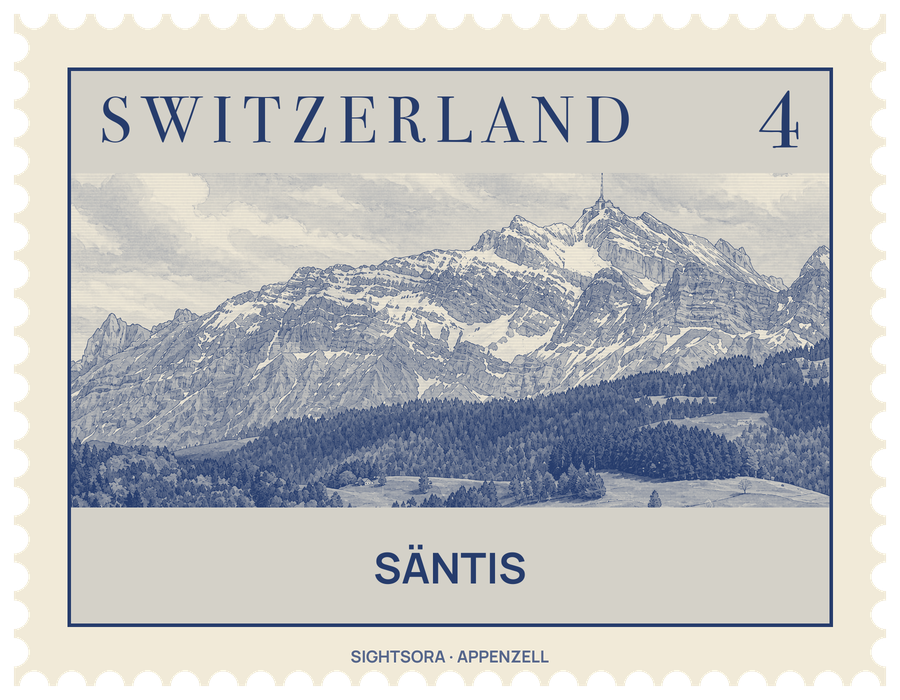
The summit stands nearly 10 kilometres south-west of the town of Appenzell, and three cantons meet on it: Appenzell Ausserrhoden, Appenzell Innerrhoden and St. Gallen. Because it sits out on the northern edge of the massif, the mountain can be seen from far away, so far that houses named Säntisblick, "Säntis view", are found as distant as the Black Forest in Germany. The reverse holds too: on a clear day the panorama from the top takes in six countries, namely Switzerland, Germany, Austria, Liechtenstein, France and Italy.
The summit carries the marks of a working mountain. A weather station has stood on the northern ridge since the autumn of 1882, built after an international meteorological congress held in Rome in 1879 called for stations on suitable summits; in the winter of 1922 the station keeper, Heinrich Haas, was killed there together with his wife, Maria Magdalena, a crime discovered only when the weather reports stopped arriving. Above the visitors' terrace rises a transmission tower 123.55 metres high, commissioned in 1997 to replace one from 1955; its antenna has a fibre-glass coat to stop ice from dropping onto the terrace. Since 2010 the tower has also held a lightning measurement station of the EPFL in Lausanne.
On the short path from the cable-car station to the summit stands a stupa, or chorten, set up in 2001 to remember the first Tibetan refugees who reached Switzerland in 1960; a plaque carries the thanks of the Tibetan community to the Swiss people and government. The name of the mountain goes back to the 9th century, as Santizo, a shortened Romansh form of the name Sambatinus, and during the Helvetic Republic it lent its name to a canton.
Tourists have been coming up since the mid-19th century, yet decades of railway schemes from nearby towns failed for lack of money. In the end Carl Meyer, a businessman from Herisau, won approval for an aerial tramway from Schwägalp at the foot of the mountain, together with a road from Urnäsch to its lower station, and the tramway opened on 1 July 1935. The installation was rebuilt between 1968 and 1976 and has had new cabins since 2000. The cable runs 2,307 metres and climbs 1,123 metres, and the ride takes roughly 8 minutes.
Getting there
The summit is reached by the Schwägalp-Säntis aerial tramway from Schwägalp, at the foot of the mountain; a mountain road leads to the lower station from Urnäsch.