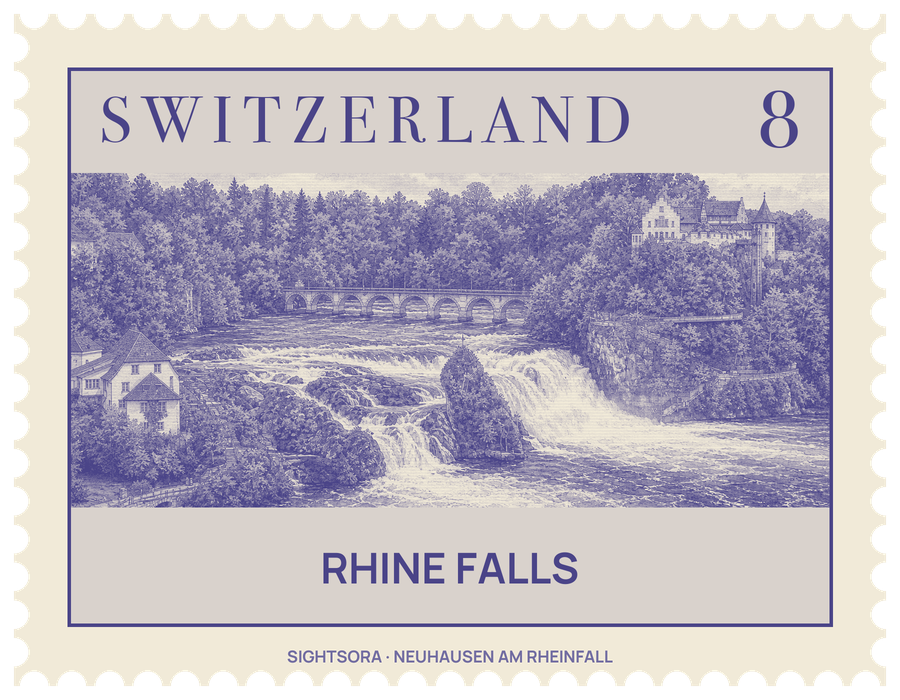
The river here forms the boundary between the cantons of Schaffhausen and Zurich, with Neuhausen am Rheinfall on the north bank and Laufen-Uhwiesen on the south. The volume of water changes a great deal through the year, averaging about 250 cubic metres per second in winter and 600 in summer; in 1965 a peak of 1,250 cubic metres per second was measured.
The falls were formed in the last ice age, roughly 14,000 to 17,000 years ago, when the glaciers pushed the Rhine south into its present bed across hard Late Jurassic limestone next to softer gravel left by earlier glaciations. Standing in the middle of the falls, the Rheinfallfelsen is a remnant of the old limestone cliff, about 150 million years old, and it has worn away very little because the river brings down only a small load of sediment from Lake Constance. How the waterfall came about is the subject of a permanent display in Schaffhausen, at the Museum zu Allerheiligen.
Laufen Castle, Schloss Laufen, stands above the falls on the Zurich side; from it a footpath leads down past the rushing water to the Fischetz platform, and guided tours of various lengths start there. Viewing platforms on both banks are reached by steep, narrow stairs, with lifts in some places. Boats cross the basin below the falls and take visitors out to the Rheinfallfelsen, where they can climb up onto the rock in the middle of the falls. On the Neuhausen side stands Wörth Castle, the Schlössli Wörth, and there are restaurants at both castles and in the Rheinfall park beside the basin. To get from one bank to the other, visitors can take a boat or walk across on a footway along the railway bridge, the Rheinfallbrücke, just upstream.
Travellers have come to see the falls since the Middle Ages. The painter J. M. W. Turner returned in the 19th century to them in sketches and in larger paintings, and Mary Shelley, who visited in 1840, described standing on the lowest platform under the arching spray in Rambles in Germany and Italy, published in 1844. The falls also survived plans to harness them: a power station was approved in 1944, but in 1951 a petition signed by 150,000 Swiss citizens, Hermann Hesse among them, stopped the project.
Getting there
Two railway stations lie within walking distance of the falls, both served by S-Bahn trains only: Neuhausen Rheinfall on the north side and Schloss Laufen am Rheinfall on the south bank. Schaffhausen station is about 3.5 kilometres away; bus line 1 is the most direct connection from there, and the nearest bus stops are Neuhausen Zentrum, Neuhausen Industrieplatz and Schloss Laufen, Rheinfall. By road, the nearest A4 motorway exits are Uhwiesen and Schaffhausen Süd.