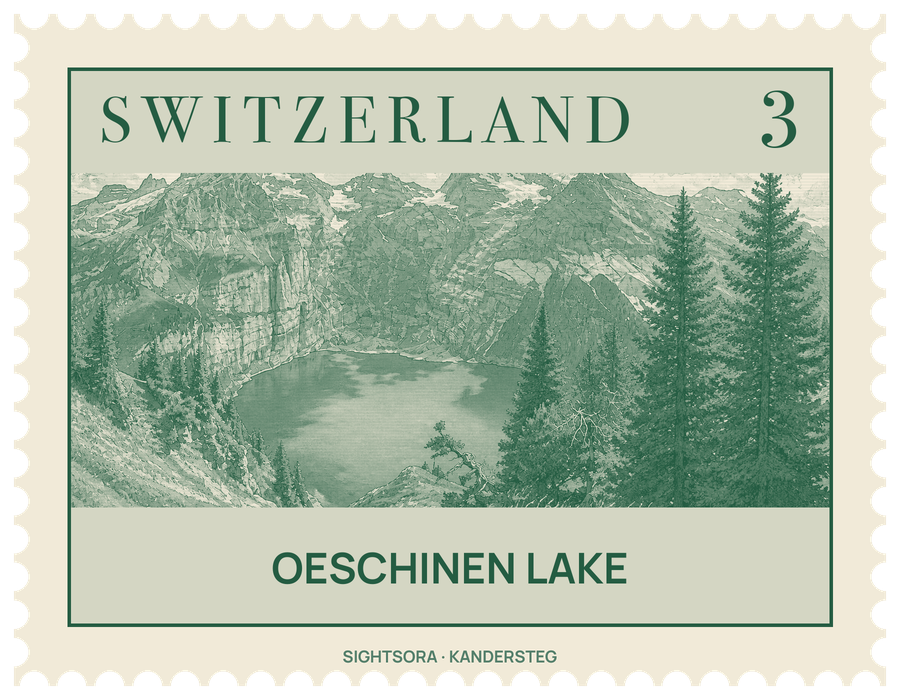
It covers 1.115 square kilometres and is up to 56 metres deep. The lake owes its existence to huge prehistoric landslides in the upper Kander valley that built a natural dam; geologists think the debris came down either from the Doldenhorn's north side or, earlier, from the Fisistock. In 2007 the lake became part of the UNESCO World Heritage Site named Swiss Alps Jungfrau-Aletsch.
In the 17th and 18th centuries sulphur was dug on the Oeschinenalp above the lake. Tourism arrived with the rise of Alpinism after 1850, bringing hotels to Kandersteg and the Oeschinensee valley, and in 1948 a chairlift was built to link the village with the lake. Today a gondola does the job, and from its top station broad paths lead down to the shore.
At the water's edge, visitors can row out on the lake in hired rowing boats, fish, or swim, and when the surface freezes, ice walks are laid out across it. The Bergrestaurant Oeschinensee stands near the shore with a sun terrace looking over the water, and there is food and a kiosk at the top station too. Near the top station a toboggan run 750 metres long winds down the slope.
Paths of every grade start from the lake. The direct path from the gondola's top station is wide and easy enough for pushchairs, and the panorama path via Läger passes alpine meadows and a viewpoint over the lake and peaks. A forest trail climbs from the valley station above the Öschibach, about 450 metres of ascent. Higher up, mountain trails lead to the Heuberg and Oberbärgli, over the Hohtürli, and to the Fründenhütte, Doldenhornhütte and Blüemlisalphütte huts; these call for proper boots and mountain-walking experience.
The cliffs above the lake are on the move. Rockfalls have long come down from the Spitzen Stein, a rocky summit of 2,974 metres above the lake and Kandersteg, and thawing permafrost has made it less stable. In May 2020 parts of the south shore were closed after geologists warned that big rockfalls could reach the water, and further trail closures followed in 2021 and in July 2025, so some routes below the mountain may be shut.
Getting there
A bus runs from Kandersteg railway station to the valley station of the Kandersteg-Oeschinensee gondola; from the gondola's top station it is a short walk down to the lake shore. On foot, the forest trail from the valley station is a demanding climb of about 450 metres.