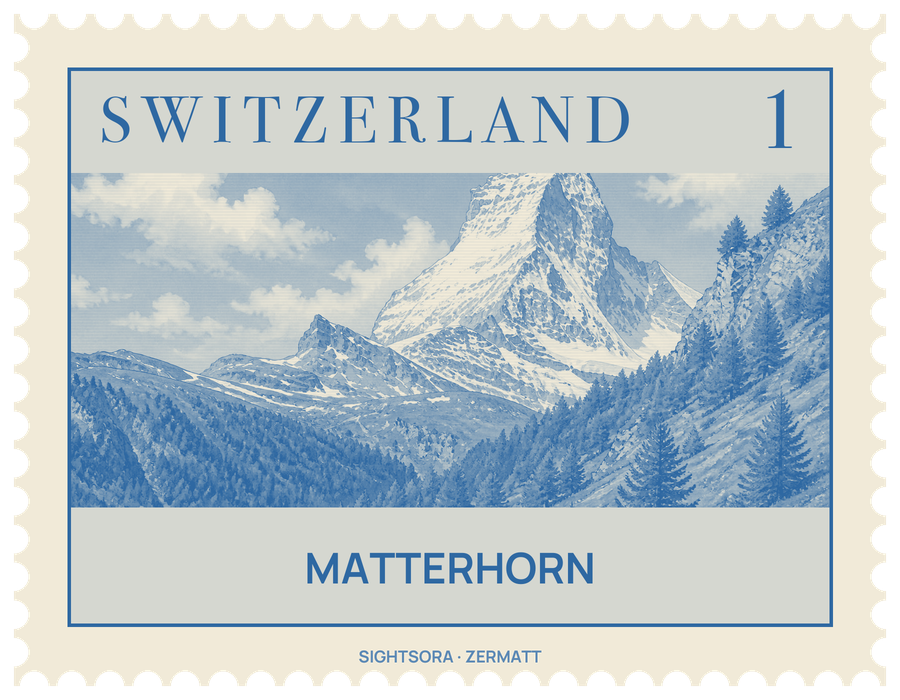
Its four steep faces point roughly to the four compass directions and are divided by four ridges: the Hörnli, the Zmutt, the Furggen and the Leone, or Lion. The name joins the German words for meadow and horn; in Italian the mountain is Cervino, in French Cervin, and the German-speaking people of the valley call it Horu. Since 1983 it has been listed in the Swiss Federal Inventory of Natural Monuments.
Ice gave the peak its shape. Over the past million years, glaciers spreading out from the top, among them the Matterhorn Glacier below the north face, ate four cirques into what had been a rounded mountain and left the sharp pyramid seen today. The faces are so steep that only small patches of snow and ice hold on them; avalanches carry the rest down to the glaciers at their feet. From about 3,400 metres to the summit the rock is gneiss from the Apulian plate, a small continent that split off from Africa before the Alps rose, which is why the Matterhorn is sometimes popularly called an African mountain. Standing alone on the main Alpine watershed, it often trails a banner cloud on its sheltered side.
The Matterhorn held out after most of the great Alpine summits had been climbed. Edward Whymper, an English engraver, had been turned back seven times, mostly on the Italian side, before he reached the top by the Hörnli ridge on 14 July 1865 together with the guides Michel Croz and Peter Taugwalder, father and son, and the climbers Charles Hudson, Lord Francis Douglas and Douglas Robert Hadow. On the way down Hadow slipped and knocked Croz over; the two dragged Hudson and Douglas off the north face, and when the rope to the elder Taugwalder snapped, four of the seven were killed. Croz, Hadow and Hudson are buried in the Zermatt churchyard, while Douglas was never found. Three days after the first ascent, Jean-Antoine Carrel and Jean-Baptiste Bich made it to the summit from the Italian side.
Whymper's book Scrambles Amongst the Alps, published in 1871, helped turn Zermatt and its valley into a destination, and the railway that reached the village in 1891 brought visitors in growing numbers. In Zermatt, the Matterhorn Museum is laid out as a reconstructed mountain village and tells the story of the first ascent with objects that belonged to the men who made it. Rail and cable-car lines climb to viewpoints around the mountain: the Gornergrat railway opened in 1898, and cable cars serve the Unterrothorn and the Klein Matterhorn at 3,883 metres.
The mountain itself is the preserve of experienced climbers: more than 500 alpinists are estimated to have died on it since 1865. Walkers can still get close. The Hörnli Hut at 3,260 metres, a large stone building at the foot of the Hörnli ridge where climbers spend the night before setting off for the summit, is within easy reach of Schwarzsee at 2,600 metres and is visited by hikers as well. For trekkers, the Tour of the Matterhorn circles the peak in about ten days through six valleys and three language areas, on demanding ground, with seven passes to cross that lie at 2,800 to 3,300 metres.
Getting there
Zermatt is reached by the railway from Visp, and the Glacier Express has linked it with St. Moritz since 1930; the village is almost entirely free of combustion-engine traffic and can only be reached by public transport. From Zermatt a cable car climbs to Schwarzsee, the starting point for the walk to the Hörnli Hut. Since 2023 the Matterhorn Alpine Crossing has connected Zermatt with Breuil-Cervinia by cable car via the Klein Matterhorn and Testa Grigia.