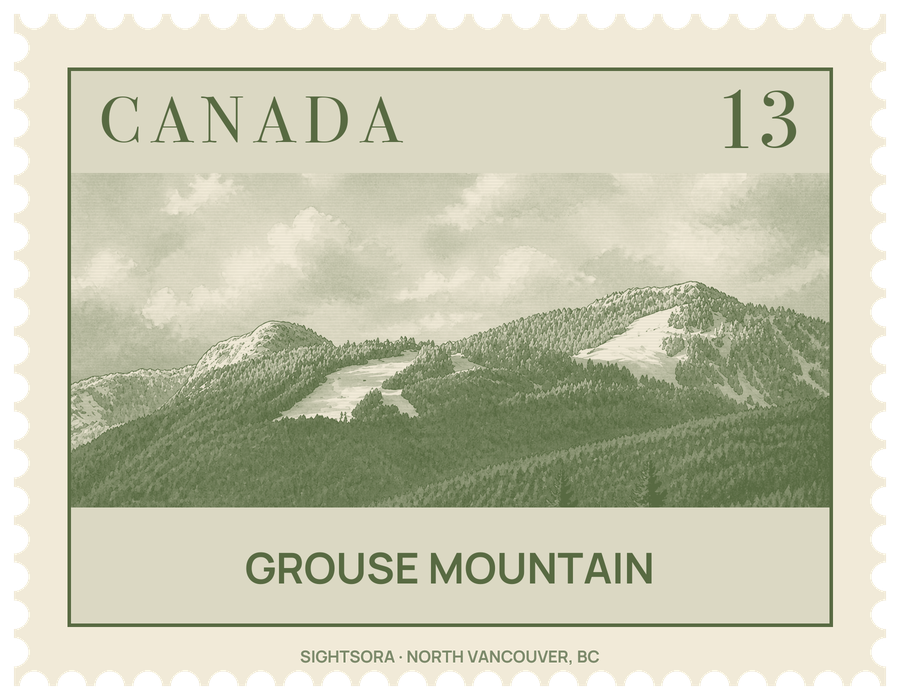
The mountain belongs to the traditional lands of the Coast Salish peoples. Its name was given in October 1894 by the earliest recorded non-Indigenous climbers to stand on top, who called it after the sooty grouse, a game bird common on its slopes.
Skiing here goes back to a lodge hand-built by Scandinavians in the 1920s, who carried the planks up the line of what is now the Grouse Grind trail. The mountain's modern shape came with aerial tramways: the Blue Tram opened in December 1966, and in 1976 a second, larger cabin line, the Red Tram or Super Skyride, was added. Holding just under 100 passengers per car, the Super Skyride is the main way up, arriving at a top terminal a short walk from the mountaintop lodge, which also houses a high-definition cinema, the Theatre in the Sky. A newer eight-person gondola, the Blue Grouse Gondola, opened in December 2024.
In winter the tram carries skiers and snowboarders to four chairlifts serving 33 runs, half of them lit for night skiing. The most visible is the Cut, a beginner run that follows the slope once used by a 1930s toll road and is easy to spot from the city below; harder runs fall away to the east from the summit, and there are three terrain parks. At the peak, a wind turbine called the Eye of the Wind, inaugurated in 2010, has an observation deck built onto its 65-metre tower.
In the warmer months the mountain is best known for the Grouse Grind, a steep trail that climbs 853 metres in 2.9 kilometres by way of 2,830 steps, earning it the nickname "Mother Nature's Stairmaster". Climbers Don McPherson and Phil Severy built it in the early 1980s as a winter conditioning trail. The average hiker takes about 90 minutes to reach the top, and many time themselves between the timers at the bottom and the summit. The trail is harder than it looks, and rescue crews bring down exhausted hikers every year.