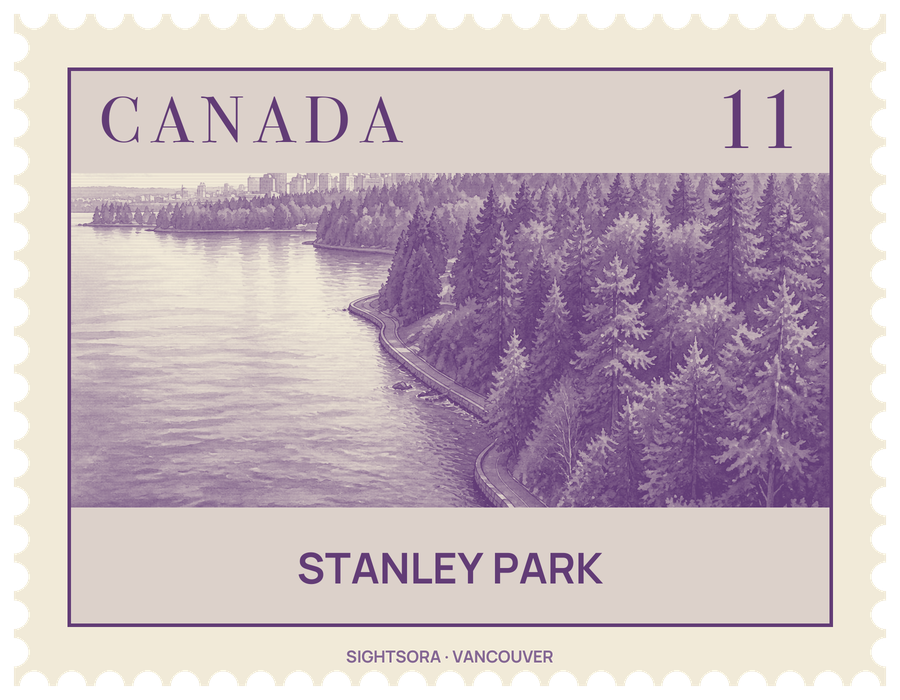
It was not laid out by a landscape architect: most of it is forest that has simply been kept, about half a million trees, some of them hundreds of years old and as tall as 76 metres. Canada listed it as a National Historic Site in 1988.
People lived here for more than 3,000 years before the park existed. The Squamish Nation had a large village called Xwayxway, meaning roughly "place of masks", where Lumberman's Arch now stands, and another settlement, Chaythoos, east of Prospect Point; a brass plaque marks its site. Residents were forced out when a road was cut around the park in 1888. The peninsula had earlier been kept as a military reserve, which spared it from logging and building, and when the new city of Vancouver leased it in 1886 it became the city's first park. It opened on September 27, 1888, named after Lord Stanley, the governor general, who dedicated it the following year.
The best way round is the Vancouver Seawall, an 8.8-kilometre path built along the park's shoreline from 1917 over several decades; the master mason James Cunningham devoted 32 years to it. Walkers and cyclists have separate lanes, and the cycling lane runs one way, counterclockwise. A full walking loop takes about two hours and a bike ride about one. Along the way are the Brockton Point lighthouse at the park's eastern tip, the 9 O'Clock Gun, a naval cannon of 1816 fired since 1898, and Siwash Rock off Third Beach, which in Squamish oral history is a fisherman turned to stone.
Inside the park, more than 27 kilometres of forest trails lead to quieter spots. Beaver Lake is almost covered in water lilies, and Beaver Creek, which drains it to the sea, is among only two streams in the city to which spawning salmon return. Lost Lagoon, a 17-hectare freshwater lake by the Georgia Street entrance, was created from a shallow arm of Coal Harbour between 1913 and 1916 and is now a bird sanctuary, with a nature house in its old boathouse. The Hollow Tree, a western red cedar stump 700 to 800 years old, has been propped up and kept as a landmark. Around 200 bird species have been recorded, including a large colony of great blue herons, but there are no large mammals.
The park also holds the Vancouver Aquarium, home to sea lions, harbour seals and sea otters; the Stanley Park Railway, a miniature train running since 1964 on ground cleared by Typhoon Freda; beaches, a heated seaside pool at Second Beach, a water spray park at Lumberman's Arch and a pitch and putt golf course. In summer, Malkin Bowl stages outdoor theatre by Theatre Under The Stars. Among the many monuments are the Japanese Canadian War Memorial and statues of Robert Burns and the runner Harry Jerome.