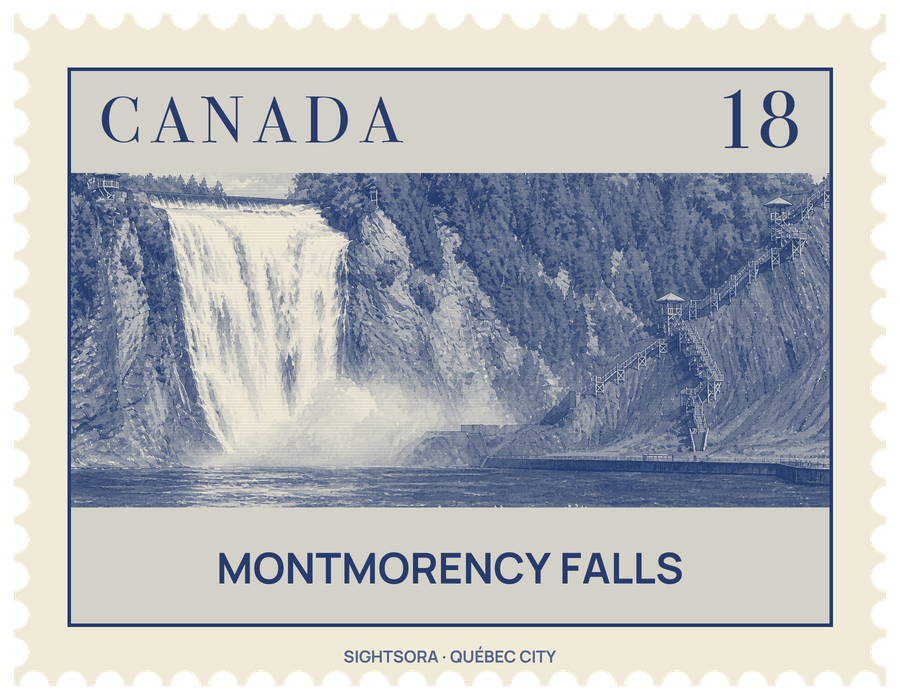
The falls mark the boundary separating Boischatel from the borough of Beauport, about 12 km from the heart of old Quebec City, and are 30 m higher than Niagara Falls. The ground around them is protected as Montmorency Falls Park (Parc de la Chute-Montmorency).
Staircases take visitors to several viewpoints on different levels, a suspension bridge crosses the crest to join the two halves of the park, and a funitel carries passengers between the base of the falls and the top. In summer the park holds an international fireworks competition with the falling water behind it, and in those months a high iron content in the riverbed lends the water a yellow glow. In winter, frozen spray builds a cone of ice at the foot of the falls, known as the Sugarloaf.
The falls have drawn artists and writers for centuries. Captain Hervey Smythe, aide-de-camp to Major General James Wolfe, sketched them from the British camp on July 31, 1759, a couple of months ahead of the Battle of Quebec, and William Elliott turned the drawing into an engraving. Robert Clow Todd painted the ice cone in 1845 and Joseph Légaré the falls in winter in 1850, while John Keats wrote of "the monstrous steep of Montmorency" in his 1816 poem Sleep and Poetry.