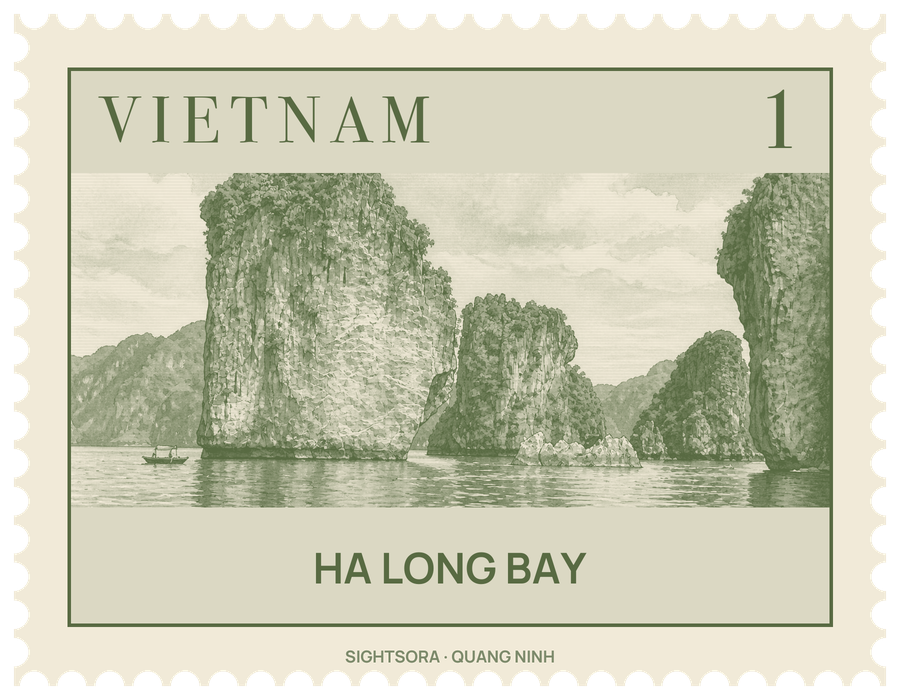
Most are steep, separate towers between 50 and 100 metres high, capped with jungle, the drowned remains of a karst landscape whose plains the sea flooded long ago. The name means "descending dragon". UNESCO first listed the core of the bay in 1994 for its natural beauty, and in 2000 added its geological value to the inscription; that core zone holds 775 islets.
Local legend explains the scenery: the gods sent a family of dragons to help the Vietnamese against invaders, and the jewels and jade they spat out turned into the islands, forming a wall that wrecked the enemy ships. The mother dragon then settled here, which gave the bay its name, while her children gave theirs to Bái Tử Long, the neighbouring bay to the northeast. Many islets carry names taken from their shapes, among them Voi (elephant), Ga Choi (fighting cock), Khi (monkey) and Con Cóc, the frog islet, and 989 of the islands have been named.
Several islands are hollow, and the caves are a large part of a visit. Đầu Gỗ, which French visitors of the late 19th century called the Grotte des Merveilles, has three big chambers full of stalactites and stalagmites, along with French graffiti from that century; tradition links its name to the wooden stakes Trần Hưng Đạo planted to sink the Mongol fleet in the 13th century. Thiên Cung, on the same island, is a single chamber more than 100 metres long, nearly divided by a wall of dripstone. Sửng Sốt, the Surprise Cave on Bo Hon Island, opens high on a cliff, and a passage over ten metres high and wide leads down from its entrance.
Other caves were cut by the sea itself, which dissolves the limestone at the foot of the cliffs and leaves notches with flat, smooth ceilings. Some run right through the hills into enclosed tidal lakes. On Bo Hon Island, Luồn Cave leads 50 metres to such a lake, and Dau Be, an island guarding the entrance to the bay, hides six lakes within its rock, the Ba Ham group among them, reached through a curving, almost dark passage about 150 metres long.
People have lived around the bay for tens of thousands of years, through the Soi Nhụ, Cái Bèo and Hạ Long cultures. The poet Nguyễn Trãi praised it five centuries ago as a rock wonder in the sky, and the Halong Bay Agreements were signed here on 5 June 1948. Fishing families live on floating houses in villages such as Cửa Vạn and Ba Hang, farming fish and shellfish in the shallow water, and some of them take visitors out by boat and serve seafood. The two larger inhabited islands, Tuần Châu and Cát Bà, have hotels and beaches.