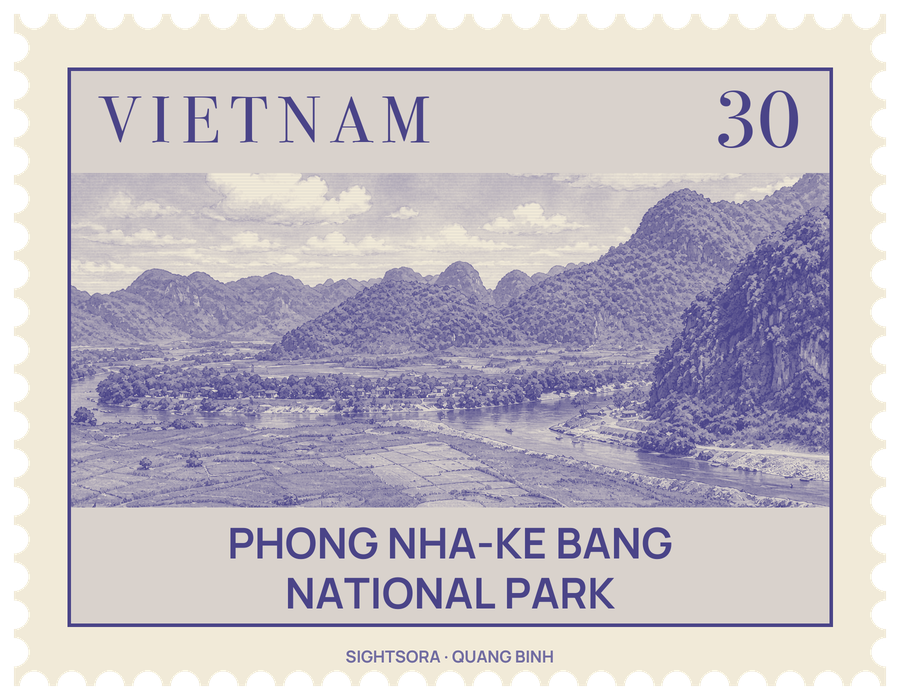
Its western edge meets the Hin Namno National Park across the border in Laos, a second karst area of similar size. UNESCO listed the park as a World Heritage Site in 2003 for its geology, and it is recognised by UNESCO as a biosphere reserve and a transboundary World Heritage Site as well. The name joins Phong Nha, the cave at its heart, with Kẻ Bàng, the limestone forest.
Shaped over some 400 million years, since the Paleozoic, this karst displays a full range of surface forms: cone and tower karst, valleys and dolines. Two dozen peaks top 1,000 metres, the highest being Co Preu at 1,213 m. The caves were carved largely by the Son and Chay rivers; the Son flows into the mouth of Phong Nha Cave, runs on underground as the Nam Aki River and resurfaces by Pu-Pha-Dam Mountain, 20 km further south. Above ground there are waterfalls such as Gió and Madame Loan, and the Mọc stream bursting out of a limestone ridge.
Phong Nha Cave itself is 7729 m long with 14 grottos, and among its named rock formations are the Royal Court, the Buddha, the Lion and the Fairy Caves. In the Outer Cave and some inner chambers the roof rises 25 to 40 meters above the water, and about 800 meters in, the Shallow Cave opens onto banks of sand and rock where stalactites and stalagmites stand like strange trees; visitors can go 1500 m into the cave. Champa inscriptions and Buddhist altars from the 9th century show that people used the cave long before it became Vietnamese, and in 1824 King Minh Mạng gave it an honorific title. A local resident stumbled on Tiên Sơn Cave in 1935, 1 km from Phong Nha's mouth and 200 meters up the slope: a dry cave 980 m long with no river, whose columns ring like gongs and drums when tapped.
Beyond these lie caves explored only in recent decades, many by the British Cave Research Association working with Hanoi University from 1990. Thiên Đường, Paradise Cave, was found in 2005. Sơn Đoòng, "Mountain River Cave", was found by Hồ Khanh in 1991 and surveyed in April 2009 by a British team led by Howard and Deb Limbert; its biggest chamber runs over five kilometers long, 200 meters high and 150 meters wide. Hang Én is 1645 m long and 78.6 m high. Tours are arranged by local operators, from boat trips into the caves to full caving expeditions, trekking and climbing on peaks above 1,000 m.
Some 96.2% of the park is forested, most of it intact primary forest, much of it rooted in the limestone. Surveys have counted 751 species of vascular plants, including a forest of Calocedrus rupestris where most trees are 500–600 years old, and three rare orchid species. The park holds ten species and sub-species of primates, among them the Hatinh langur, the black langur, François' langur and the white-cheeked crested gibbon, along with the mainland serow, the giant muntjac, Asian black bears and sun bears, Sunda pangolins and the Annamite striped rabbit. More than 200 bird species live here, including the brown hornbill and the red-collared woodpecker.
Getting there
Đồng Hới is the nearest city: it has a station on the Hanoi-Saigon Railway, and Đồng Hới Airport lies 45 km south of the park; Huế is another common starting point. Visitors are received at the Tourism Service Center in Phong Nha township, whose entrance is beside the Hồ Chí Minh Highway, and from there boats carry them up the Sơn River to Phong Nha Cave.