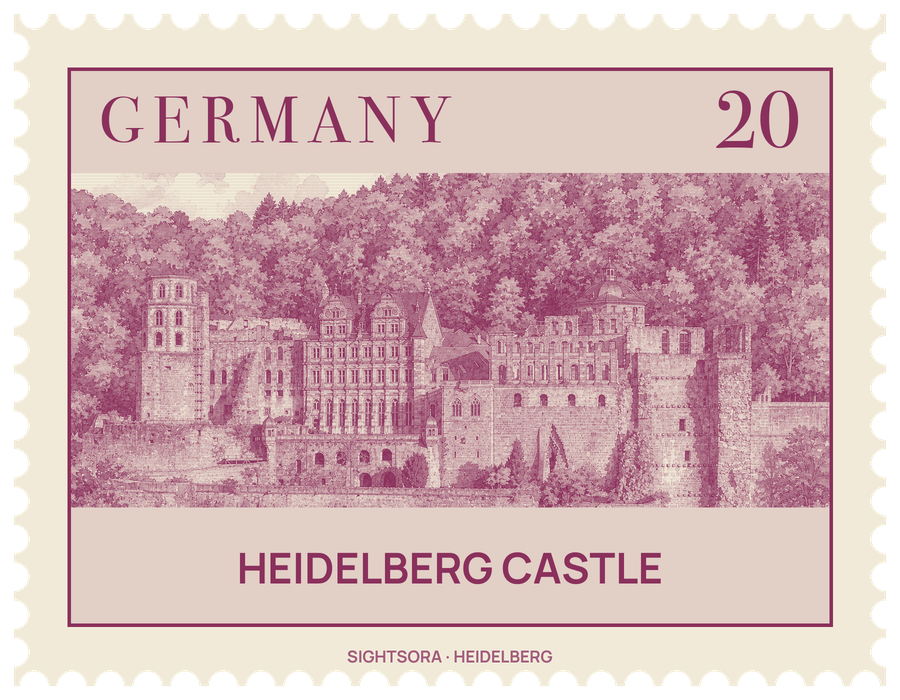
This was the seat of the Counts Palatine of the Rhine until war, fire and lightning reduced it to a shell. It was only partly rebuilt after the destruction of the 17th and 18th centuries, and since the 19th century travellers from all over the world have seen in its broken walls the essence of Romantic Germany; J. M. W. Turner returned to the town repeatedly from 1817 to 1844 and painted the castle many times, placing it far higher on the hill than it really sits.
A lower castle stood on this spot, the Jettenbühl, by 1303, and the electors kept enlarging it into a fortified palace. Frederick V had the Elisabeth gate built for the costly festivities of his marriage to Elizabeth Stuart, daughter of the English king, and Salomon de Caus returned with the couple from England; soon after, work began on the Hortus Palatinus, a huge garden that first required the slope to be reshaped. His acceptance of the Bohemian crown in 1619 drew the Thirty Years War to Heidelberg, and General Tilly took town and castle in 1622. Worse followed in the War of the Grand Alliance: French troops set the castle on fire as they withdrew in March 1689, blowing the front off the Fat Tower, and in 1693 they blew up with mines the towers and walls that had survived. In 1720 the court moved to Mannheim, and when lightning struck twice on 24 June 1764 and set the buildings ablaze again, the elector Karl Theodor gave up his plan to return.
For decades the ruins served as a quarry, until the French count Charles de Graimberg, who arrived to make sketches of the castle and never left, spending his last 54 years in Heidelberg, took up their cause. He fought the government of Baden over their preservation, kept watch from the Glass Wing to stop townspeople carrying off stone, documented the ruins in prints that drew tourists, and gathered finds that became the core of the Kurpfälzisches Museum. A commission later decided the castle should be preserved as a ruin rather than rebuilt, so only the Friedrichsbau was restored, by Karl Schäfer around the turn of the 20th century.
Visitors cross a stone bridge over a partly filled ditch and pass the main gate of 1528 into the forecourt. The Friedrichsbau, built for Elector Friedrich IV between 1601 and 1607 by the architect Johannes Schoch, has statues of the electors' ancestors on its façades; the ground floor holds the court chapel, with the prince's rooms on the floors over it, and it came through fires in 1693 and 1764 as the best-preserved part of the castle. Beside it stand the arcaded balconies of the Gläserner Saalbau and the courtyard façade of the Ottheinrichsbau. In the gardens, a stone tablet on a ruined aviary wall carries verses by Marianne von Willemer about her last meeting with Goethe, and the Upper Prince's Fountain bears the monogram of Karl Philipp and the date 1738.
Classic guided tours of the castle are complemented by themed tours and family tours with crafts for children aged six to ten during school holidays. The castle is also associated with Perkeo, the court jester whom Charles III Philip put in charge of the castle's wine stocks and who later became the city's unofficial mascot.
Getting there
The Heidelberger Bergbahn funicular, which climbs from Kornmarkt in the old town to the summit of the Königstuhl, stops at the castle at an intermediate station. A footpath up to the castle begins at the Palace Graimberg, the count's former house.