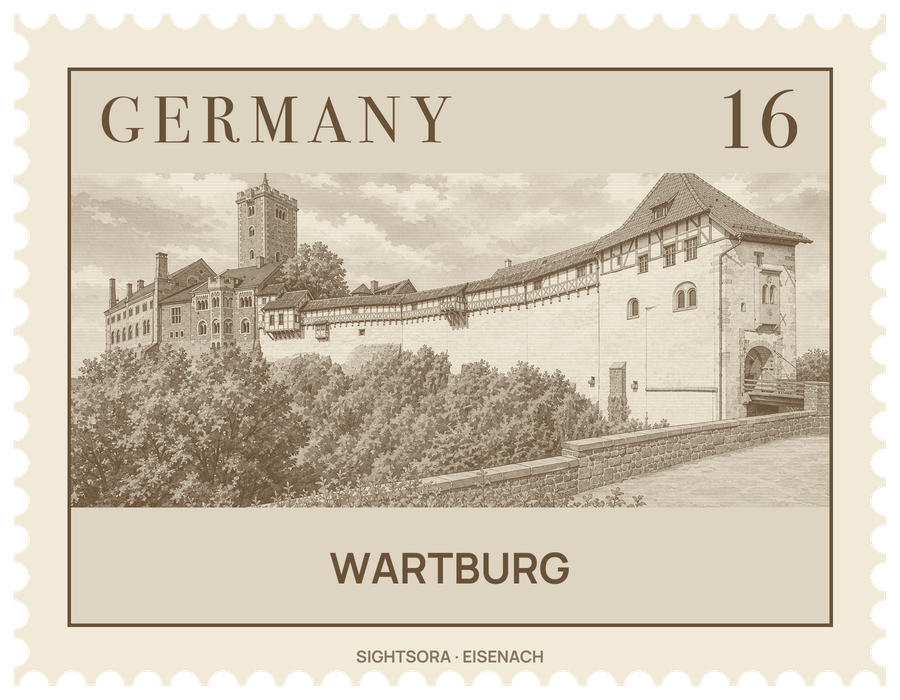
Its story goes back almost 1000 years, to around 1067, when Louis the Springer laid its foundations, and within its walls St. Elisabeth of Hungary lived, Martin Luther translated the New Testament into German, and students gathered in 1817 to call for German unity. Original buildings from the 12th to the 15th centuries survive, though much of the interior was recreated in the 19th century. UNESCO added the castle to the World Heritage List in 1999.
Between 1172 and 1211 the court of the landgraves of Thuringia drew poets: Wolfram von Eschenbach worked on part of his Parzival here in 1203, and Walther von der Vogelweide was another of the court's poets; and the castle became the setting of the legendary Sängerkrieg, a contest of minstrels that Richard Wagner later turned into his opera Tannhäuser. Elisabeth arrived as a four-year-old to be raised as the future wife of Landgrave Ludwig IV, and lived here from 1211 to 1228, known for her charity. Luther came in May 1521, hidden for his own safety after the Diet of Worms, and lived until March 1522 as Junker Jörg, translating the New Testament from Greek in just ten weeks.
After centuries of decline, Grand Duke Karl Alexander ordered the castle rebuilt in 1838 as a national monument in the Neo-Romanesque style, with Hugo von Ritgen as architect. That rebuilding shaped much of what visitors see, and it inspired Ludwig II when he came to build Neuschwanstein. The only way in is still over the drawbridge and through the barbican, which have changed little since the Middle Ages, into the Vorburg, a courtyard of half-timbered buildings from the 14th and 15th centuries. In the Vogtei is the Lutherstube, the room where Luther stayed, with paintings by Lucas Cranach. The Bergfried of 1859, built on the base of the medieval keep, carries a three-metre cross, and the Romanesque South Tower of 1318 has a dungeon beneath it.
The largest building, the Palas, dates from 1157 to 1170 and was built in a late Romanesque style. Some of its rooms, such as the Rittersaal and the Speisesaal, keep original pillars and beamed ceilings, while others show how the 19th century imagined the Middle Ages: the Elisabeth-Kemenate is lined with mosaics of the saint's life made in 1902–06, the Sängersaal has Moritz von Schwind's frescoes of the minstrels' contest, and the Festsaal on the top floor is decorated with more of his frescoes. The Neue Kemenate holds the castle's art collection, with paintings by Lucas Cranach the Elder and sculpture from the workshop of Tilman Riemenschneider.
The interiors are seen on guided tours, and the castle also has a museum; the foundation offers overview tours and workshops on medieval castle life, Elisabeth and Luther, and a children's audio guide for the outdoor areas can be downloaded. Children can make the climb on a donkey. Concerts are held in the Festsaal, as are performances of Tannhäuser, and a hotel from the 19th-century rebuilding stands next to the castle.